


I wasn’t looking for a revelation on a country road in southeastern Illinois. But on the outskirts of Galatia — a tiny town where Appalachian hardship seems to have drifted west and settled in — that’s what I found.
It was not a burning bush in some biblical wilderness, but an industrial 3D printer the size of a small garage — a machine, I would learn, that took a $1.1 million investment to get to Illinois, carrying with it the promise of an affordable housing renaissance across the region known as Little Egypt.
And it called to me.
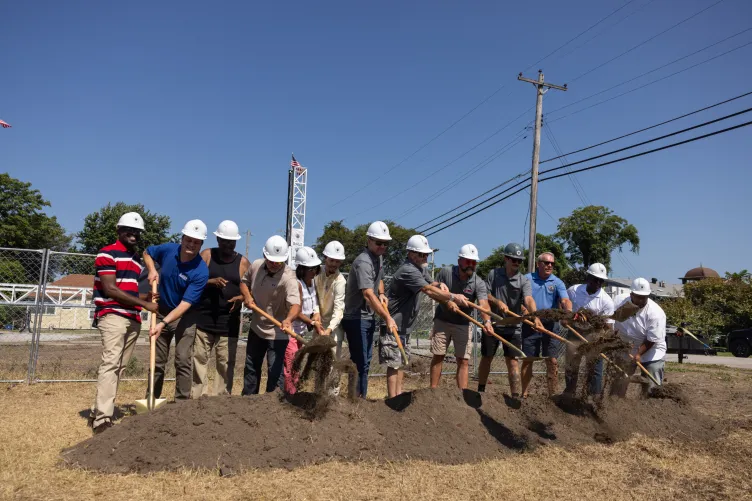
I drove past it again and again. A year prior, in August 2024, this printer was at the center of a groundbreaking ceremony attended by more than 100 people, myself included. I covered the event for Capitol News Illinois and watched as the machine laid down the first layers of what was supposed to be a new beginning. Two local men had promised to help save Cairo, Illinois, by using the machine to print new homes in a town that desperately needed them.
I watched as state and local politicians ceremoniously tossed dirt. Officials posed for photographs beside the machine, holding it up as proof that a new era had arrived. They promised fast, efficient, modern homes — and with them, the sense that someone, at last, was paying attention to this corner of the state.
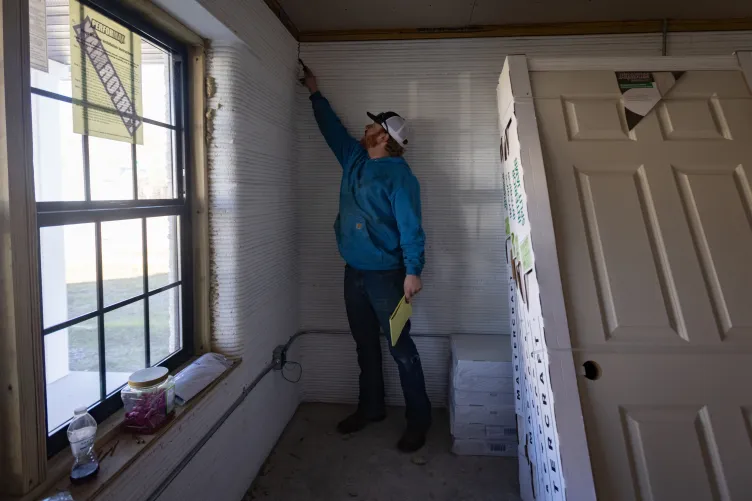
A year later, though, the printer had produced the framing for exactly one duplex — but the project was abandoned before the interior was finished. Before anyone could move in, the walls cracked.
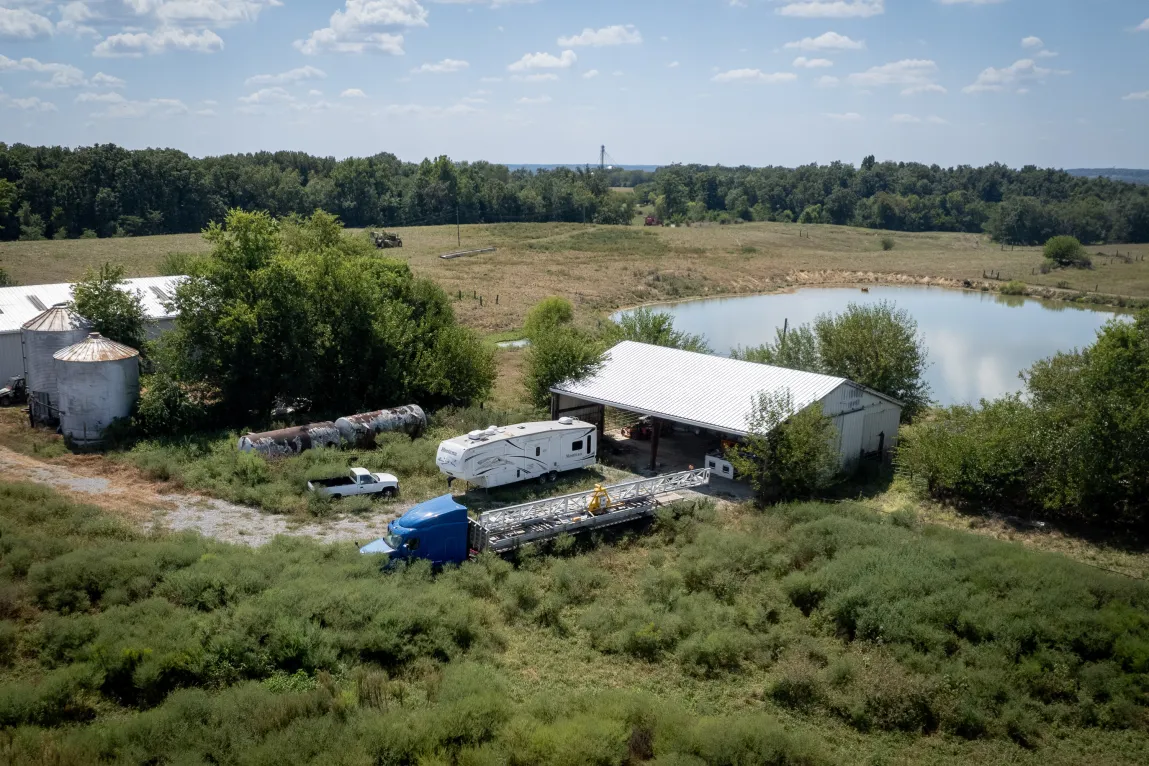
When I started to investigate what had gone wrong, I found the printer disassembled on a flatbed truck at a country repair shop that doesn’t need to advertise because you either know it’s there or you wouldn’t be going anyway.
The more I stared at it, and continued to drive by it, I wondered how a promise as large as housing had been left to rust in the sun and rain. What did this abandoned printer say about false promises so often made in the name of saving rural America? About officials who insist they are trying to help? And, at the heart of it, how did this quite expensive piece of modern technology become abandoned here in the first place?
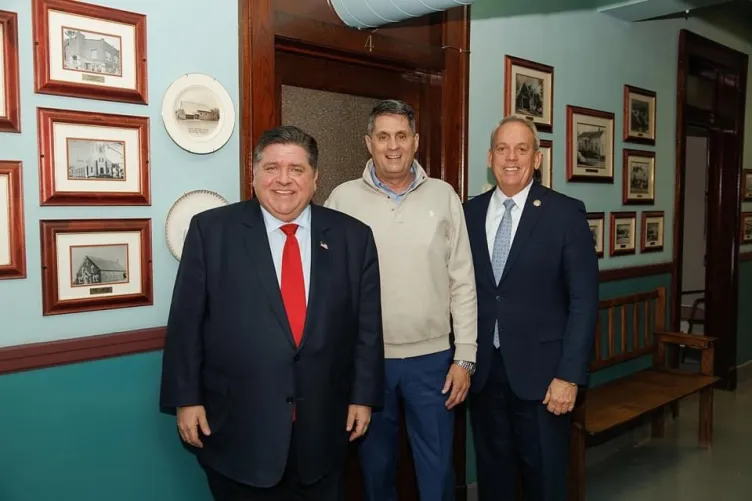
For an investigation I published with ProPublica in collaboration with Capitol News Illinois, I sought answers to those questions. I followed what became one of the most windy and wild reporting journeys of my life. I learned that, behind the scenes, the project to build 3D housing in Cairo had been ushered along by political connections: State Sen. Dale Fowler, whose district includes Cairo, helped introduce the 3D printing company to top leaders, including Gov. JB Pritzker and U.S. Sen. Tammy Duckworth’s office. The company, Prestige Project Management Inc. — in the same Harrisburg, Illinois, high rise as Fowler’s district office — pitched the project as part of the state’s housing future.
A Pritzker spokesperson said the governor’s office took no action after meeting with Prestige. A Duckworth spokesperson said the senator’s office had just revived discussions about how to address Cairo’s housing crisis when Fowler reached out and that the office did not have additional involvement with the company. Fowler took an active role boosting the company’s project in Cairo but said he just wanted to see housing development in the city and wasn’t otherwise involved in Prestige’s business dealings.
What I assumed would be a simple story instead got weird — part Old Testament prophecy, part Facebook rumor mill weird.
I’d learn that within a few months of that groundbreaking party, the work stopped on the duplex. After the owners of Prestige said dozens of cracks started running through the walls, a half-dozen employees quit the company. Not long after, the FBI launched an investigation into Prestige’s broader business dealings. There have been no charges or arrests, and the owners say they have fully cooperated with investigators and have done nothing wrong. They also said the concrete “ink” that came with the printer was faulty and that’s why the printer has been idle since. Black Buffalo 3D, the printer supplier, said it has offered Prestige a new concrete solution and to find a buyer for the printer if Prestige no longer wants it.
I spent months digging through records and speaking with Prestige’s owners, former employees and others who’d done business with the company, trying to piece together a timeline of the company’s dealings in Cairo and beyond. Along the way, I encountered intense interviews, moments of tears, strange contradictions and a swamp of rumors.
And in the middle of it all, I found myself pulled in, too — whispering prayers in my car, chasing the truth like a storm rolling off the Shawnee, loving this place with my whole chest and still wondering: What in the hell happened here?
At the same time, maybe part of me already knew what happened, in a way. The failed promise of housing in Cairo is a story I’ve written over and over, for more than a decade.
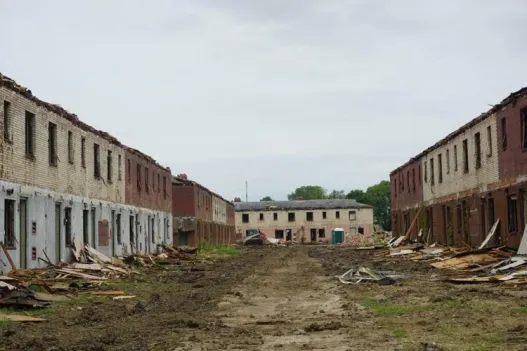
I’ve written about how mold, mice, lead-tainted water and decay persisted in the city’s public housing, at one time home to a fourth of the town, for generations. I’ve written about misspending by public housing officials, the federal takeover that followed and the long, painful effort to tear down what could not be salvaged. For years, federal officials promised even as housing was being torn down that it would be rebuilt. The plan, they said, depended on private companies working alongside government agencies, and on innovation. In this light, things like 3D construction printers seemed to fit exactly with their vision.
So when Prestige Project Management Inc. in Harrisburg, backed by a state senator, offered to buy a printer and deliver it straight to Cairo — on what one of its owners described as a mission from God — people believed.
What was the alternative?
In Cairo, I’ve learned, progress (and the illusion of it) carries its own kind of grief. The demolition of public housing less than a decade before hollowed out a town already on its knees. People were forced to choose between opportunity elsewhere and home, between safer housing and the place that made them.
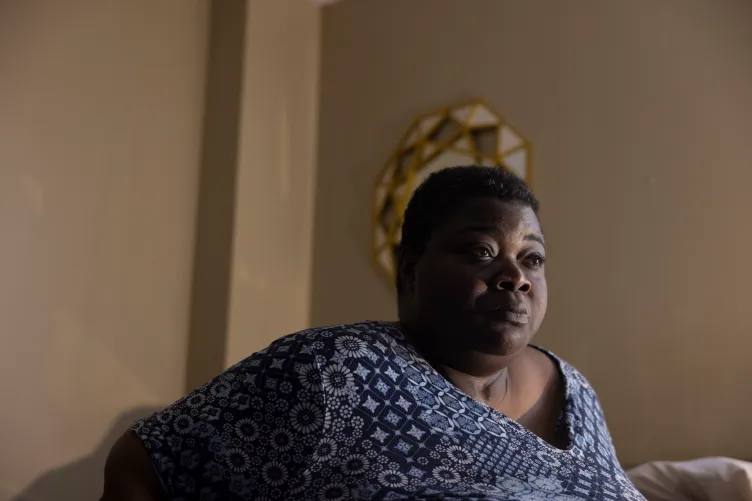
And the emotional gravity of this story wasn’t from the strangest things I encountered, but from the ones that were the most real and heartbreaking: a town that raised its hopes, only to see them, once again, dashed. A mother living in a cramped one-bedroom unit across town who’d dreamed of moving into one of the duplex’s two-bedroom units, finally able to give her 6-year-old daughter a space of her own.
Some towns, I’ve heard people say, cannot be saved.
I understand the argument. I’ve felt it myself, driving the backroads of southern Illinois between the two great rivers that meet at Cairo, through a landscape marked by poverty, abandonment and a stubborn struggle to hang on. But Cairo has always seemed worth saving to me, because of its history, its suffering and its resilience, a word that can feel too neat for what Black residents there have endured: racism and exclusion that lingered long after much of the South began to change.
Is an unfinished 3D-printed housing spectacle really the best we have to offer?
I’ve written thousands of stories by now. Most disappear as soon as they’re filed. But a few stay in the bones.
This is one of them.
此内容由惯性聚合(RSS阅读器)自动聚合整理,仅供阅读参考。 原文来自 — 版权归原作者所有。