






These highlights were written by the reporters and editors who worked on this story.
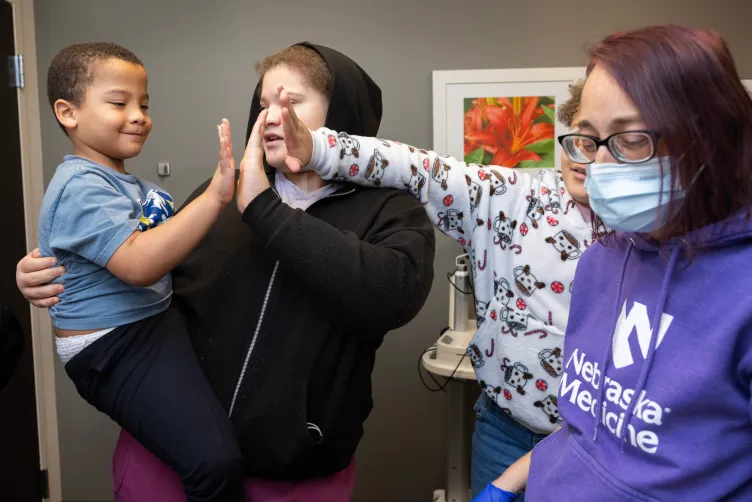
Belinda Daniels panicked in 2018 when the pediatrician said her 1-year-old son, Jovanni, had lead in his body. The toxic metal could stunt his brain, the doctor told her, but catching it early meant she could prevent more damage.
Daniels moved out of her Omaha, Nebraska, apartment that had chipping lead paint. The doctor continued testing Jovanni periodically while Daniels followed instructions on cleaning, handwashing and keeping Jovanni away from contaminated dirt.
Eventually, the lead level in Jovanni’s blood dropped. While the now-8-year-old has anger and impulse-control issues, Daniels said it could have been a lot worse.
“They told me that the side effects of it would be him being autistic” or having “very delayed behaviors,” she said.
Not every child’s high lead levels are caught as early as Jovanni’s. In Nebraska, it’s largely up to the doctor or health system to decide whether to test a child’s blood for lead. As a result, local public health officials say, not enough kids are getting tested, given Omaha’s lead problems, which include being home to the largest residential lead cleanup site in the country.
For more than a century, smoke from a lead smelter and other factories deposited 400 million pounds of the toxic metal across the city’s east side. That prompted the Environmental Protection Agency to begin investigating the pollution in 1999, and a few years later, the agency declared 27 square miles of east Omaha to be a Superfund site. Over more than two decades, the EPA and the city have dug up and replaced nearly 14,000 yards, from about a third of the site’s residential properties.

Faced with similar public health concerns about lead, 13 states, including New Jersey, Louisiana and neighboring Iowa, have passed laws requiring universal lead screening, meaning all kids would get a blood test before entering kindergarten.
But not Nebraska.
Most places passed these laws after recognizing that they were reaching too few kids by simply targeting high-risk groups like children who live in old housing. Every state with available data saw increases in the number of kids tested after passing these laws, the Flatwater Free Press and ProPublica found. Some identified more kids with elevated blood lead levels.
A lack of consistent testing nationally leads health officials to miss about half the kids with high levels, according to research by the American Academy of Pediatrics. The academy and the Centers for Disease Control and Prevention recommend testing in areas that have a high prevalence of lead or older housing.
Over the years, Omaha public health officials have raised awareness about blood testing with billboards and community events about the risks of lead. But a bill to require that every child be tested failed in the Nebraska Legislature in 2011. Since then, there have been no efforts to revive it.
Naudia McCracken, supervisor of the Douglas County Health Department’s Lead Poisoning Prevention Program, said she is planning to propose an ordinance to the Omaha City Council this summer. That could require health workers to test all kids up to age 7 who live in the Superfund site itself and a broader area east of 72nd Street, generally thought of as the dividing line between the city’s urban east side and suburban west side. Right now, fewer than half of kids under 7 in that area are tested for lead.
As a whole, the county’s testing rate is better than most, CDC data shows. But that’s not comforting to local health workers. “That number is abysmally low,” said Peg Schneider, a physician assistant who has been testing Omaha kids for lead since 1989 and believes every kid should be tested.

McCracken said the city “needs to come to grips” with its lead problems. Not only is it home to the Superfund site, but the majority of east Omaha’s housing was built before lead paint was banned, and many residents’ drinking water travels through lead pipes. While Daniels lived in the Superfund site, she believes her baby might have been exposed to the apartment’s lead paint.
Since the cleanup began, the percentage of kids in the Superfund site whose tests showed high lead levels has decreased from 33% in 2000 to 2.4% in 2025. That mirrors national trends over the same time period.
But east Omaha still has a higher rate of children with elevated blood lead levels than the national average, according to the most recent CDC data.
Without mandatory testing, there’s no way to know if health workers are missing kids with potentially life-changing exposures to lead, said Dr. Jennifer Sample, a Kansas City, Missouri-area pediatrician and former chair of the American Academy of Pediatrics’ Council on Environmental Health and Climate Change.
“That’s why I support universal testing: so we can actually see where those kids are,” she said. “We need better data.”
Getting an accurate picture of the community’s blood lead levels is not only important for public health. While levels of lead in soil are the main drivers for EPA action, the data on children’s blood lead levels can inform decisions like lowering cleanup thresholds, said Kellen Ashford, an EPA spokesperson. The EPA is currently reassessing the site, and tens of thousands more Omaha properties could be cleaned up.
Jim Woolford, who led the EPA’s Superfund program from 2006 to 2020, worries that if kids with lead poisoning aren’t being tested and the community’s levels appear low, EPA officials may use that data as a reason not to carry out a remediation project that could cost hundreds of millions of dollars.
Instead, Woolford said, they could “declare victory” and “move on.”

In 1977, Douglas County, which contains Omaha, took advantage of a new federal grant and started a screening program to test kids for lead. By then many communities in the U.S. recognized the dangers of the toxic metal and had begun passing laws to catch and address its effects.
But in Omaha, local officials struggled to test enough kids with limited resources. Four health workers went door to door with suitcases full of swabs and vials. Dr. John Walburn, who treated lead-poisoned kids at the time, tried to convince doctors at Omaha’s clinics and hospitals to test, but, outside poor areas, “they did not see it as their problem,” he said.
After the EPA proved lead contamination was a far-reaching problem and began the Omaha cleanup in 1999, testing increased dramatically as the EPA and local government recommended kids in the Superfund site be screened. But many still went unchecked, said Brenda Council, a longtime lead poisoning prevention advocate in the city.
So when she won a seat in the Nebraska Legislature, she proposed that every child in the state undergo at least one blood lead test before kindergarten unless a health care worker determined the child to be at low risk for lead poisoning using a questionnaire. Some believed the survey would flag too many kids and result in unneeded tests.
“Among the things in that checklist are that they’ve never ingested a nonfood product,” Paul Schumacher, a state senator from Columbus, Nebraska, said at the time. “It would be un-American for a kid not to have eaten dirt or grass at some time in its life.”

The bill eventually passed the Legislature but was vetoed by then-Gov. Dave Heineman, who said it was unnecessary and would be too costly.
“There could have been so much prevention,” Council said. “That opportunity was lost.”
Heineman did not return phone calls, texts or emails requesting comment. Schumacher said in an interview that he still believes a one-size-fits-all approach would test kids unnecessarily but said a local policy for a place with lead issues would make more sense.
Without universal testing, Nebraska policymakers and health institutions have taken different approaches. The state recommends testing every kid who lives within the Superfund site at ages 1 and 2. Douglas County recommends kids be tested annually until age 7.
Only 1- and 2-year-olds with Medicaid insurance are required to be tested — and even then, only two-thirds of eligible kids in the county are tested each year, according to state data.
Providers in the biggest medical systems are left to follow individual policies. OneWorld Community Health Centers, which serves primarily low-income and Latino patients in South Omaha, requires its providers to try to test every 1- and 2-year-old. Children’s Nebraska, the state’s only independent pediatric hospital, requires one test by 2 years old. Nebraska Medicine, the state’s largest hospital network, does not have its own policy, according to a spokesperson. But Schneider, the physician assistant at Nebraska Medicine’s Fontenelle Health Center in North Omaha, said she tests kids annually until the age of 5.

In recent years, several states that had similar approaches realized they weren’t catching enough kids with high lead levels. In Maine, more than 160 such children were likely missed due to inconsistent screening across the state, according to a 2019 report by a Maine affordable housing group. Since then, the state has passed a universal testing law and its health department reported that its testing rate, which had been stagnant for years, was now rising.
Michigan passed a new universal testing law in 2023. The state previously relied on recommendations similar to Nebraska’s, and parents had to push doctors to get their kids tested, said Ellen Vial, a Detroit program manager at the Michigan Environmental Council, which lobbied for the law. She hopes the new law will do as much to prevent exposure there as banning lead from paint did.
Nebraska state Sen. Ashlei Spivey of North Omaha said she’s considering introducing lead-related policies again in the Legislature, such as bills to increase testing, provide tax credits to fix lead paint issues inside homes and enforce the replacement of water service lines that contain lead.
The EPA has been reexamining Omaha’s Superfund site, particularly how contaminated dirt has to be to qualify for cleanup. One factor that may influence the cleanup decision is local blood lead data. In 2019, the EPA wrote in a review of the Omaha site that its plan “may not protect children,” given that the CDC had lowered the concentration at which it considers someone’s blood lead level “high.”
Nearly 27,000 Omaha properties could have qualified for cleanup if the EPA applied guidance that had been set under the Biden administration to better match the updated advice on blood lead levels, according to documents obtained by the Flatwater Free Press and ProPublica. But those guidelines were rolled back last fall by the Trump administration, tempering some experts’ expectations and residents’ hopes for additional cleanup. The EPA plans to have updates on its Omaha cleanup plans by the end of the year, agency spokesperson Ashford said.
Ashford also said the EPA uses local blood lead data, when it’s available, to set or lower cleanup levels. The local data also helps establish whether other remedies are needed, such as interior dust screenings or repainting homes that have lead paint.

But using blood data to understand the prevalence of lead is problematic, said Danielle Land, a University of Iowa public health researcher. Lead only stays in the blood for about 30 days, meaning an exposure can be missed even though it can continue to cause damage. Testing kids in winter when they spend more time inside versus summer when they’re playing outside can also provide different results. Isolating how someone was exposed or whether a cleanup is behind a decline in blood lead levels can be difficult.
Despite those issues, Land said she’s seen declines in the number of kids with high blood lead levels “shape public and institutional narratives” about whether to investigate or fix hazards in places like Flint, Michigan, where millions have been spent replacing lead pipes, or Anniston, Alabama, where the soil was contaminated. In 2018, the EPA said blood lead data in Omaha could shape how the agency conducts cleanups elsewhere.
Industries and local government officials have used low blood lead levels to avoid cleanups before, said Larry Zaragoza, a retired EPA employee who spent decades analyzing and developing policies relating to lead risk.
In the 1990s, a Colorado county and the state argued against widespread cleanup in the town of Leadville, Zaragoza said. Residents spent years criticizing the EPA’s research and felt the agency was unfairly saddling corporations that owned local mining operations with cleanup costs, news reports show. Cleanups only happened at homes where kids’ blood tests came back as high or where yards contained nearly nine times the levels required to qualify for a cleanup in Omaha.
Still, the agency needs a way to measure success, said Woolford, the former Superfund program director. The data can be valuable if enough kids are tested and they generally represent the area.
“You’re going to need, even with all its uncertainties, some indicator of what’s happened over time,” he said.
As Jovanni gets older, Daniels said her fear for his health has dissipated. Her son loves Ferraris and Dodge Challengers. He wrestles, plays soccer and rides his bike.
But he was also exposed to lead, which can carry lifelong consequences similar to the behavioral issues he’s dealing with. Daniels wonders how many other parents have kids like him but may never know why.
“I think that needs to be standard across the board — all kids getting tested,” she said.

此内容由惯性聚合(RSS阅读器)自动聚合整理,仅供阅读参考。 原文来自 — 版权归原作者所有。