





The United States was once a leader in the collection and utilization of public health data. As the COVID-19 pandemic wears on, the United States must resume its leadership in this domain.
During the pandemic, numerous lives were lost and still more people became chronically ill with “long-haul COVID” due in part to gaps in U.S. public health data systems. Shortcomings with these data systems directly underlay the need to shut down key sectors of the economy, causing millions of lost jobs and bankruptcies. The widespread shutdowns were necessitated by the lack of data on both community prevalence of the disease and COVID-19 immunity status, which in turn forced the need to treat wide geographic areas of the United States as under threat.
To address these gaps and ensure we are ready to meet future public health challenges, we require a centralized, cloud-based system for use in tracking infectious diseases and chronic conditions. We have named this system the Nationwide Reportable Conditions Data System (NRCDS).
At the outset, the NRCDS would be used for reporting data on the 121 “reportable” diseases and conditions such as COVID-19, influenza, mumps, and cancer. Currently, testing entities (such as Quest) and providers (such as doctors’ offices) are required to report data on these conditions to the nation’s 2,300 state and local public health agencies within 24 hours.
The myriad, disparate reporting locations create a tremendous burden for reporting entities that are simply trying to comply with a Federal reporting mandate. Additionally, these thousands of public health agencies largely host their reportable conditions data on-premises in legacy systems. Starting with the Modernizing Government Technology Act of 2017 (MGT), the Federal government has sought to drive government agencies away from such systems toward more efficient cloud-based operations.
The single, unified, cloud-based NRCDS would align with Federal initiatives like MGT and the Cloud Smart Strategy. Initially, NRCDS data would be comprised of the 31 data elements mandated by the CARES Act Section 18115, reportable condition stipulations for COVID-19. However, the Centers for Disease Control (CDC) has expressed interest in expanding such a platform in the future to include the other 120 reportable conditions as well as further data streams including immunizations, Admission-Discharge-Transfer (ADT) events, electronic Case Reporting (eCR), and Electronic Health Record (EHR) data.
Expanding the NRCDS in the ways proposed by the CDC would enable the creation of a rich longitudinal record of infectious disease diagnoses, immunizations, EHR data about chronic health conditions, and healthcare utilization in the United States – COVID-19-related and otherwise. This data system would have endless crucial uses. For example, the monitoring of COVID-19 could take place at all geographical scales–a capability lacking during the current pandemic – closing an important information gap. Furthermore, for public health case management and education purposes, it could be used to monitor and assist individuals who were vulnerable to a given infectious disease.
We propose a second, cloud-based system that is ensconced within the NRCDS – which we have named the COVID Repository – to track functional immunity status to COVID-19. The COVID Repository would contain information on U.S. residents’ COVID-19 and antibody test results as well as vaccinations. Additionally, it would include viral strain (variant) information to the extent available. The length of time that immunity to COVID-19 lasts is still being studied, and it may only last several months. Once this time window is known, because the COVID Repository is a longitudinal record, it would allow the determination of the approximate “expiration date” of immunity after an infection or vaccine. Figure 1 presents the NRCDS and the associated master COVID Repository, in identifiable and de-identified forms, that would be developed from it. A government agency or contractor permitted to handle personally identifiable health information would maintain the database. Information would be shared with the Federal Aviation Administration, the Federal Emergency Management Agency, the Department of Defense, intelligence agencies, and several other government stakeholders.
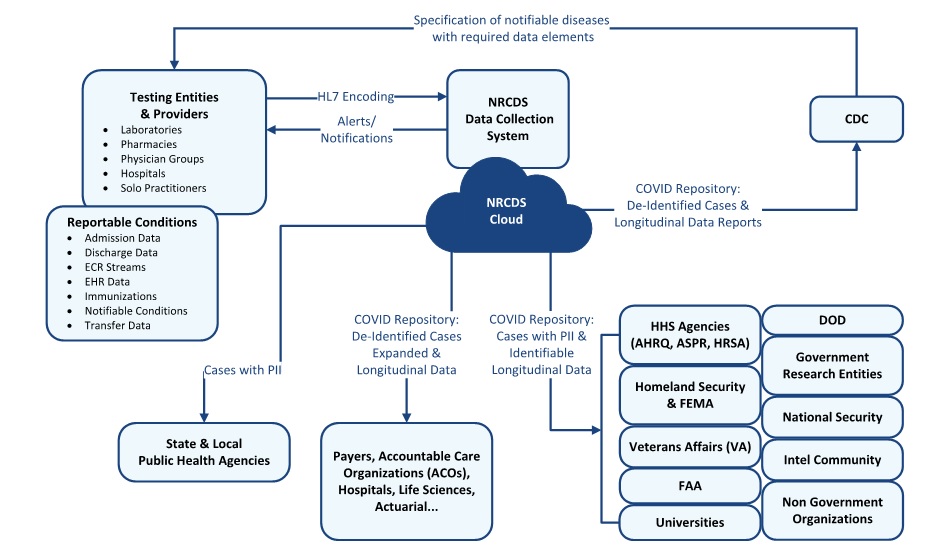
Ideally, the COVID Repository data would be combined with the other longitudinal health data in the NRCDS so the long-term effects of COVID-19 and its effect on other chronic conditions could be established. The data set would assist U.S. agencies with managing the long-haul COVID-19 caseload, allowing insights that could reduce the burden for U.S. health care and social systems. The data would additionally be maintained and made available in de-identified form to research agencies, nongovernmental organizations, and health care companies, making it an invaluable resource for research.
The NRCDS and COVID Repository would allow for much more accurate public health monitoring. They would also be much more efficient than the current legacy systems and save money. As recently as 2017, many government agencies were spending over 75 percent of their budgets on maintaining legacy systems that were becoming siloed as they failed to integrate with newer technologies. Finally, in an era when the nation’s COVID-19 and other health data are among the top targets of international cybertheft efforts, the cloud-based systems’ increased security would safeguard U.S. residents’ personal health information.
 David Dastvar serves as chief growth officer with Eagle Technologies. In his 29 years with public sector and Fortune 1000 companies (including GDIT/CSC, Infosys, CDI, Maximus/Attain, and Northrop Grumman), he has developed and managed professional services and solutions for enterprise-level projects requiring a high degree of program management and technical expertise.
 Linda Hermer, Ph.D., leads the Research Team at Eagle Technologies. Dr. Hermer earned her undergraduate degree at Harvard University in Neurobiology and Linguistics and her doctoral degree from Cornell University in Psychology. She was an accomplished neuroscientist and cognitive psychologist before dedicating the second half of her career to improving public health 10 years ago. Since then, she has worked to modernize public health and social science research at universities, nonprofit organizations, and for-profit firms.
此内容由惯性聚合(RSS阅读器)自动聚合整理,仅供阅读参考。 原文来自 — 版权归原作者所有。