


惯性聚合 高效追踪和阅读你感兴趣的博客、新闻、科技资讯
阅读原文 在惯性聚合中打开

推荐订阅源

Cyber Security Advisories - MS-ISAC
Application and Cybersecurity Blog
T
Threat Research - Cisco Blogs
Latest news
Latest news
Project Zero
Project Zero
TaoSecurity Blog
TaoSecurity Blog
Cyberwarzone
Cyberwarzone
Threat Intelligence Blog | Flashpoint
Google DeepMind News
P
Privacy & Cybersecurity Law Blog
T
Troy Hunt's Blog
cs.AI updates on arXiv.org
AWS News Blog
AWS News Blog
Hacker News: Ask HN
Hacker News: Ask HN
S
Security @ Cisco Blogs
C
Cisco Blogs
Help Net Security
Help Net Security
I
Intezer
W
WeLiveSecurity
Exploit-DB.com RSS Feed
腾讯CDC
S
Secure Thoughts
MyScale Blog
MyScale Blog
Recorded Future
Recorded Future
G
GRAHAM CLULEY
L
LINUX DO - 热门话题
A
About on SuperTechFans
C
CXSECURITY Database RSS Feed - CXSecurity.com
IT之家
IT之家
J
Java Code Geeks
The Hacker News
The Hacker News
阮一峰的网络日志
阮一峰的网络日志
Scott Helme
Scott Helme
Recent Announcements
AI
AI
Cisco Talos Blog
Cisco Talos Blog
B
Blog RSS Feed
V
Vulnerabilities – Threatpost
C
Check Point Blog
Security Latest
Security Latest
S
SegmentFault 最新的问题
T
The Exploit Database - CXSecurity.com
cs.CL updates on arXiv.org
M
MIT News - Artificial intelligence
T
The Blog of Author Tim Ferriss
Attack and Defense Labs
PCI Perspectives
PCI Perspectives
Recent Commits to openclaw:main
T
Tailwind CSS Blog
Apple Machine Learning Research

Cisco Blogs

Cisco Live 2026: Bringing the Future of Customer Experience to Las Vegas Edge opportunity for service providers: Turn infrastructure into new services MRC and SRv6: How Foundational Networking Innovations Are Enabling the Next Generation of AI Supercomputers The SMB Marketing Reset: Winning Customer Trust in a Digital-First Economy Inside the SOC: AI-powered DNS defense against ransomware Our Path Forward Securing the Federal Digital Experience with Cisco ThousandEyes for Government Cisco at ONUG Dallas 2026: Securing the AI Data Center in the Agentic Era Cisco and Red Hat are powering intelligent core to edge: Red Hat Summit insights Building the Capabilities That Win: How Cisco Partners Can Lead in the SMB & Mid-Market Era How Two Hours Felt Bigger Than My To-Do List Announcing Foundry Security Spec Ace the CCIE Collaboration Lab: Success Tips from a TAC Engineer Turned CCIE Protecting Agents with Cisco AI Defense and Google Agent Development Kit Powering an Inclusive Future: Your guide to the Purpose Pavilion at Cisco Live Las Vegas The Infrastructure Behind the Mission: SOF Week 2026 Cisco Networking App Marketplace Partners at Cisco Live 2026 Beyond the Pilot: Building the Clinical Data Fabric for the Agentic Era Benchmarking scale-out AI fabrics with Cisco N9000 + AMD Pensando™ Pollara 400 NICs Month of Developer Productivity: Build and Forget The race to autonomous transport networks: A new study Lean IT, future-ready: How to save time and simplify wireless management with AI Reading Between the Pixels: Failure Modes in Vision Language Models Biochar’s triple win: Healthier soils, improved crops, and decarbonization Designing a Proactive Customer Journey Modernize your data center operations with Cisco Nexus Dashboard Why your automation stack needs Cisco Agentic Workflows Try Cisco AI Defense Explorer Edition in this hands-on lab From Bandwidth to Intelligence: How Cisco is Powering AI-Ready Networks Spotlight on digital transformation | FY25 Purpose Report Galaxy Mode is live: A limited-time look at what your Cisco AI Assistant and AgenticOps can already do Securing the Agentic Workforce: Cisco Announces Intent to Acquire Astrix Security Understanding CISA BOD 26-02: Mitigating Risk from End-of-Support Edge Devices Digging Deeper: The Future of Mining with Automation and Ultra-Reliable Wireless Voices from the field: Helping farmers build resilient local economies across rural America Built like a startup, scaled like Cisco: Transforming data center cooling for the AI era Defining Model Provenance: A Constitution for AI Supply Chain Safety and Security Introducing Model Provenance Kit: Know Where Your AI Models Come From Security Insights: A Threat-First View for the Platform That Enforces Access How I Turned My Curiosity into a Patent From Strategy to Architecture: How Cisco is Building a Quantum-Safe Future Maximizing Managed Security Services: A Strategic Guide to Optimizing Your Portfolio (Part 1 of 2) Simplify access control in five easy steps Trust: Why security is your next growth engine Cisco IQ is generally available. Here’s what that actually means. From Vision to Reality: Intelligence in Action with Cisco IQ How connectivity is shaping the future of surgical care The power of your network: Solving a physical security incident on Vision portal 5 signs your data center is holding your AI strategy back Stop Overthinking OT Security: The Total Cost of Ownership and Being Smart with Refreshes AI-Ready, Simpler, and More Secure WAN: Cisco SD-WAN Innovations Scaling the digital future: Why AI and skills investments matter for business and society Expanding our Product Organization Recap Scaling the Future: Reddit AMA on Network Automation at Scale Bringing Professional-Level Skills to Cisco Networking Academy Announcing Cisco Availability in Google Cloud Marketplace: A New Path to Scalable, Partner-Led Growth The Innovation Paradox: How We Reduced Incidents by 25% While Deploying Faster Funding the AI-ready data center: Why flexibility wins The switch that quantum networking has been waiting for From a Message I Couldn’t Believe to a Stage I’ll Never Forget The Hidden Bottleneck Slowing Down Manufacturing Transformation 30 Years as a CCIE: Why Certifications Matter in the AI Era Securing Enterprise AI: Cisco AI Defense Expands to Google Cloud How ThousandEyes Closed the Cloud Visibility Gap by Solving It Themselves First Introducing the AI Agent Security Scanner for IDEs: Verify Your Agents Stop Overthinking OT Security: People, Process and Technology Powering the Future of Research: Join Cisco at NLIT 2026 Building the Digital Foundation for a Smarter West Lincoln Memorial Hospital How Cisco built an AI-RRM that maximizes your wireless solution From Automation to Autonomy: Cisco and Rockwell Power a New Era for Manufacturing Unlocking the Future of Fan Engagement: The Power of VisionEDGE Find Yourself in the Future: AI Is the New Baseline—Here’s How to Build Your Skills One Day with Our Customers: Driving better outcomes through customer centricity What It Really Takes to Build an AI-First Workforce From Connectivity to Security: How E80 Future-proofed its AGV Operations with Cisco The Infrastructure of a Floating City: AIDA Cruises’ CX-Led Digital Transformation Scaling your network for AI without a forklift upgrade Why modern networks are moving DDoS defense to the edge Evolve IP Media to AI-Driven Media Fabrics: Future-Proof Broadcast with Cisco and NVIDIA Cisco and Generation are scaling AI-powered pathways to employment Reading Between the Pixels: Assessing Prompt Injection Attack Success in Images Lean IT, future-ready: Why Wi-Fi is your AI growth strategy Cisco Modeling Labs: Bringing the Network Digital Twin to Life AI on the Factory Floor: Why Manufacturing Requires a New Architecture with Cisco Unified Edge Designing for What’s Next: Securing AI-Scale Infrastructure Without Compromise Scaling the Future: Join Our Reddit AMA on Network Automation at Scale 5 wireless trends retail IT teams can’t ignore in 2026 Can your infrastructure management tools do that? Sustainability 101: Let’s talk about energy efficiency From Chai Breaks to Checkpoints: A Day at Cisco Bengaluru Preparing for Post-Quantum Cryptography: The Secure Firewall Roadmap Non-Obvious Patterns in Building Enterprise AI Assistants Making AI Trustworthy and Observable in Real-Time: Cisco Announces Intent to Acquire Galileo A simpler path to unified, AI-ready network operations Cisco Celebrates The Smart Industry Industrial Transformation Award Winners Mobile World Congress 2026: AI-powered Network Security Powering MWC Barcelona – Building a Unified SOC and NOC with Splunk in Record Time How New Data Streams Transformed Cisco Store’s Decision-Making AI-powered Network Security at the Mobile World Congress 2026 SNOC Inside the Mobile World Congress 2026 SOC: Detecting Shadow Traffic with Firepower 6100
Energy Will Define the Scale of AI
Mary de Wyso · 2026-04-22 · via Cisco Blogs

In France, Cisco is working with a major European bank to design a next-generation artificial intelligence (AI) data center. This new system is being built to reduce energy costs and shrink the bank’s AI compute footprint. It combines high-density compute, immersive cooling, and advanced network automation to manage the growing demands of AI workloads.

As this system comes together, we’re offered an early view of how AI infrastructure will need to operate at scale. Systems will need to balance performance with realities of power, cooling, and space. At the intersection of networking, compute, security, and sustainability, Cisco is addressing this challenge.

The way progress is measured is shifting. Performance still matters. But the system’s ability to sustain it will determine AI’s speed and growth. And the gap between what AI requires and what infrastructure can reliably deliver is emerging as one of the defining challenges of our time.

Trust in AI will increasingly be shaped at the infrastructure layer: in how energy is managed, how systems are secured, and how organizations account for their impact. That is the lens through which Cisco approaches sustainability in the AI era. Not as a parallel priority, but as an important determinant of performance, cost, resilience, and trust.

The energy constraint is real

AI is advancing at extraordinary speed. But the systems that power it are evolving at a different pace.

Global data center electricity demand is projected to more than double by 2030, compared to 2024, according to the International Energy Agency. At the same time, the IEA estimates that grid constraints could delay up to 20% of planned capacity. AI is scaling within real limits around power, cooling, materials, and infrastructure resilience. Those limits are beginning to reshape how technology is governed, financed, and deployed.

Inquiries from our customers around topics like energy efficiency, energy consumption, and materials use continue to increase in volume and complexity. This points to a broader change in operating requirements.

We cannot simply outbuild the energy challenge. We have to out-engineer it.

We are applying that same discipline to our own operations, working toward Cisco’s public goal to reach net zero greenhouse gas emissions across our value chain by 2040.

The role Cisco plays

Cisco sits at the intersection of networking, compute, and security. At this infrastructure layer, digital systems and energy systems converge, requiring constraints to be managed in real time.

Our role is to help customers and communities scale innovation responsibly and sustainably, within real-world constraints. That includes enabling greater energy efficiency, making energy use more visible and auditable, extending the life cycle value of infrastructure, and securing increasingly distributed environments.

Security and resilience are closely tied to sustainability. As AI systems become more distributed and energy systems more digitized, the attack surface expands. For critical infrastructure operators and regulators, security and sustainability frameworks should be designed in parallel, not sequentially. Protecting the grid, the data centers that support AI, and the networks that connect them requires secure, observable, and resilient infrastructure by design.

For Cisco, this means enabling more, responsibly, and at scale.

Why collaboration matters now more than ever

No single organization can address these challenges alone.

The convergence of AI and energy is reshaping regulatory, economic, and infrastructure systems simultaneously. This is an opportunity to coordinate across technology providers, utilities, policymakers, and global institutions.

As one step to deepen that collaboration, Cisco has joined the Coalition for Sustainable AI, contributing to global dialogue on responsible, energy-efficient, and trustworthy AI development.

This reflects a shared recognition: the future of AI will be influenced not just by compute advances, but by how effectively energy systems are managed as part of the broader infrastructure.
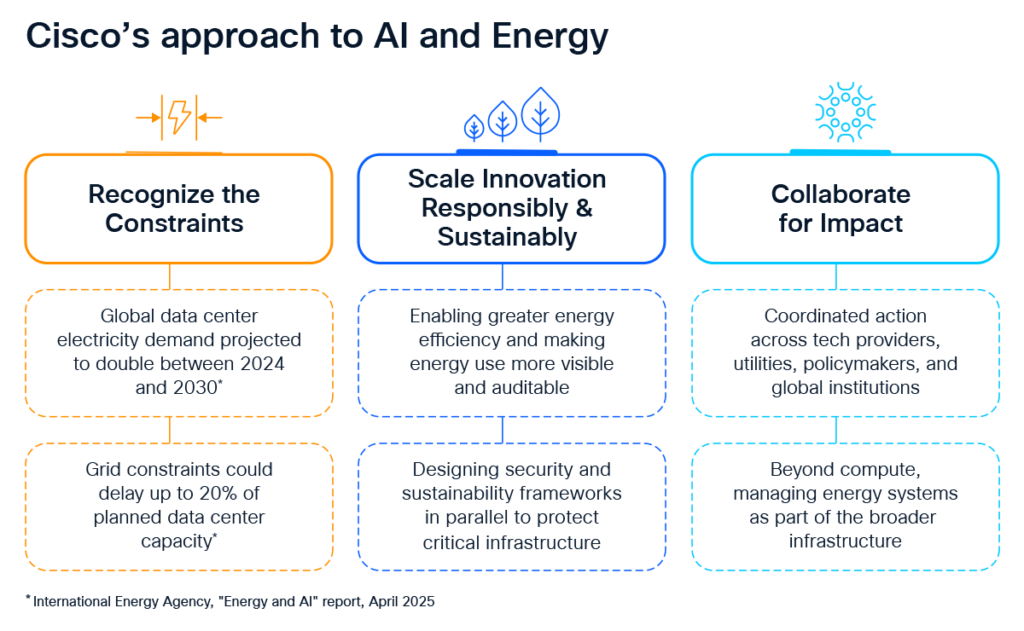
Infographic titled "Cisco's approach to AI and Energy" outlining three strategic pillars: Recognize the Constraints: Highlights that global data center electricity demand is projected to double between 2024 and 2030, and grid constraints could delay up to 20% of planned data center capacity. Scale Innovation Responsibly & Sustainably: Focuses on enabling greater energy efficiency, making energy use visible and auditable, and designing security and sustainability frameworks in parallel to protect critical infrastructure. Collaborate for Impact: Emphasizes the need for coordinated action across technology providers, utilities, policymakers, and global institutions, and managing energy systems as part of the broader infrastructure. Source: International Energy Agency, "Energy and AI" report, April 2025.What sustainability means in the AI era

Sustainability shapes how systems are designed, operated, and governed.

While many organizations focus on AI as a compute challenge, it is equally a power, cooling, materials, and infrastructure resilience challenge. As digital and energy systems converge, energy is increasingly managed as part of the digital infrastructure itself. The network becomes a control layer, providing visibility, coordination, and security across environments, from campus to data center to grid. Increasingly, AI itself is part of the solution, helping optimize cooling loads, predict grid stress, and allocate energy more intelligently across distributed systems.

Visibility enables informed decision-making.

Through Cisco Energy Management and our observability platforms, organizations can measure, manage, and report energy use with greater precision. This supports more informed decision-making, stronger compliance, and transparent reporting.

Efficiency becomes a system requirement.

At Cisco, many of our products exhibit high performance per watt, as demonstrated by our Silicon One architecture and UCS platforms. Our smart building solutions use Power over Ethernet to reduce wasted energy while improving operational control. At our Penn 1 office retrofit in New York City, these approaches contributed to a 36% reduction in energy use while maintaining performance and occupant comfort. In fiscal 2025, Cisco sourced renewable electricity to match 100% of our annual electricity needs for all Cisco owned and leased property globally (approximately 1.4 million megawatt-hours), with progress tracked publicly in our annual Purpose Report.

Resilience depends on a modernized grid.

Our Industrial IoT portfolio helps utilities digitize, secure, and optimize operations, integrating distributed energy sources while supporting reliability. This is where digital and physical infrastructure intersect, and where secure connectivity is increasingly essential.

Sustainability also requires infrastructure built to last. We design products for durability, repairability, and reuse. Today, 100% of new Cisco products and packaging incorporate Circular Design Principles. Programs like Cisco Refresh extend product life cycles, reduce waste, and provide cost-effective alternatives for customers managing tighter capital constraints.

Enabling AI at scale, responsibly

Our customers balance competing demands for performance, security, and sustainability. Many of our largest customers have established their own sustainability and emissions reduction goals. They depend on trusted data, efficient infrastructure, and secure systems to meet them, and increasingly, so do the regulators and investors evaluating them.

At Cisco, we focus on enabling AI within real-world constraints:

  • Efficient infrastructure that operates within power and cooling limits
  • Energy visibility and operational control to support compliance and reporting
  • Secure, distributed architectures that help protect critical systems
  • Grid-aware solutions that support resilience and stability
  • Circular design that helps preserve life cycle value and reduce waste
  • Reliable sustainability data management that supports customer requirements

The Path forward

The innovators in that Paris data center are not only trying to solve for today. They are helping define what scalable AI looks like in practice. The infrastructure decisions made in the next several years are likely to shape how AI scales for decades.

AI will be one of the most consequential technologies of our era. But its success, and its trustworthiness, will depend in part on whether it can scale sustainably and responsibly. Efficiency helps set the pace. Security and resilience help determine whether that growth can be trusted. And sustainability helps connect them.

Getting this right will require more than engineering. It should include partnership across industry, government, and the institutions that support both.

At Cisco, we believe the future of AI will be built on infrastructure that is efficient, secure, resilient, and accountable by design.

Learn more about our approach to energy and sustainability in the Cisco Purpose Reporting Hub.