
惯性聚合 高效追踪和阅读你感兴趣的博客、新闻、科技资讯
阅读原文 在惯性聚合中打开

推荐订阅源

B
Blog
C
Cybersecurity and Infrastructure Security Agency CISA
Microsoft Security Blog
B
Blog RSS Feed
云风的 BLOG
云风的 BLOG
G
Google Developers Blog
Recent Announcements
A
About on SuperTechFans
cs.AI updates on arXiv.org
Google Online Security Blog
Google DeepMind News
S
Schneier on Security
S
Secure Thoughts
T
The Exploit Database - CXSecurity.com
Martin Fowler
Martin Fowler
P
Proofpoint News Feed
Security Latest
Security Latest
Jina AI
Jina AI
D
Darknet – Hacking Tools, Hacker News & Cyber Security
Recorded Future
Recorded Future
T
Tor Project blog
有赞技术团队
有赞技术团队
H
Hackread – Cybersecurity News, Data Breaches, AI and More
N
News | PayPal Newsroom
博客园 - 三生石上(FineUI控件)
MyScale Blog
MyScale Blog
cs.CV updates on arXiv.org
Last Week in AI
Last Week in AI
F
Full Disclosure
Hacker News: Ask HN
Hacker News: Ask HN
Forbes - Security
Forbes - Security
D
DataBreaches.Net
人人都是产品经理
人人都是产品经理
NISL@THU
NISL@THU
C
Cisco Blogs
Recent Commits to openclaw:main
Google DeepMind News
Project Zero
Project Zero
IT之家
IT之家
T
Threatpost
Cyberwarzone
Cyberwarzone
O
OpenAI News
cs.CL updates on arXiv.org
J
Java Code Geeks
P
Proofpoint News Feed
The Last Watchdog
The Last Watchdog
月光博客
月光博客
Latest news
Latest news
MongoDB | Blog
MongoDB | Blog
Apple Machine Learning Research

Cisco Blogs

Edge opportunity for service providers: Turn infrastructure into new services MRC and SRv6: How Foundational Networking Innovations Are Enabling the Next Generation of AI Supercomputers The SMB Marketing Reset: Winning Customer Trust in a Digital-First Economy Inside the SOC: AI-powered DNS defense against ransomware Our Path Forward Securing the Federal Digital Experience with Cisco ThousandEyes for Government Cisco at ONUG Dallas 2026: Securing the AI Data Center in the Agentic Era Cisco and Red Hat are powering intelligent core to edge: Red Hat Summit insights Building the Capabilities That Win: How Cisco Partners Can Lead in the SMB & Mid-Market Era How Two Hours Felt Bigger Than My To-Do List Announcing Foundry Security Spec Ace the CCIE Collaboration Lab: Success Tips from a TAC Engineer Turned CCIE Protecting Agents with Cisco AI Defense and Google Agent Development Kit Powering an Inclusive Future: Your guide to the Purpose Pavilion at Cisco Live Las Vegas The Infrastructure Behind the Mission: SOF Week 2026 Cisco Networking App Marketplace Partners at Cisco Live 2026 Beyond the Pilot: Building the Clinical Data Fabric for the Agentic Era Benchmarking scale-out AI fabrics with Cisco N9000 + AMD Pensando™ Pollara 400 NICs Month of Developer Productivity: Build and Forget The race to autonomous transport networks: A new study Lean IT, future-ready: How to save time and simplify wireless management with AI Reading Between the Pixels: Failure Modes in Vision Language Models Biochar’s triple win: Healthier soils, improved crops, and decarbonization Designing a Proactive Customer Journey Modernize your data center operations with Cisco Nexus Dashboard Why your automation stack needs Cisco Agentic Workflows Try Cisco AI Defense Explorer Edition in this hands-on lab From Bandwidth to Intelligence: How Cisco is Powering AI-Ready Networks Spotlight on digital transformation | FY25 Purpose Report Galaxy Mode is live: A limited-time look at what your Cisco AI Assistant and AgenticOps can already do Securing the Agentic Workforce: Cisco Announces Intent to Acquire Astrix Security Understanding CISA BOD 26-02: Mitigating Risk from End-of-Support Edge Devices Digging Deeper: The Future of Mining with Automation and Ultra-Reliable Wireless Voices from the field: Helping farmers build resilient local economies across rural America Built like a startup, scaled like Cisco: Transforming data center cooling for the AI era Defining Model Provenance: A Constitution for AI Supply Chain Safety and Security Introducing Model Provenance Kit: Know Where Your AI Models Come From Security Insights: A Threat-First View for the Platform That Enforces Access How I Turned My Curiosity into a Patent From Strategy to Architecture: How Cisco is Building a Quantum-Safe Future Maximizing Managed Security Services: A Strategic Guide to Optimizing Your Portfolio (Part 1 of 2) Simplify access control in five easy steps Trust: Why security is your next growth engine Cisco IQ is generally available. Here’s what that actually means. From Vision to Reality: Intelligence in Action with Cisco IQ How connectivity is shaping the future of surgical care The power of your network: Solving a physical security incident on Vision portal 5 signs your data center is holding your AI strategy back Stop Overthinking OT Security: The Total Cost of Ownership and Being Smart with Refreshes AI-Ready, Simpler, and More Secure WAN: Cisco SD-WAN Innovations Scaling the digital future: Why AI and skills investments matter for business and society Expanding our Product Organization Recap Scaling the Future: Reddit AMA on Network Automation at Scale Bringing Professional-Level Skills to Cisco Networking Academy Announcing Cisco Availability in Google Cloud Marketplace: A New Path to Scalable, Partner-Led Growth The Innovation Paradox: How We Reduced Incidents by 25% While Deploying Faster Funding the AI-ready data center: Why flexibility wins The switch that quantum networking has been waiting for From a Message I Couldn’t Believe to a Stage I’ll Never Forget The Hidden Bottleneck Slowing Down Manufacturing Transformation 30 Years as a CCIE: Why Certifications Matter in the AI Era Securing Enterprise AI: Cisco AI Defense Expands to Google Cloud How ThousandEyes Closed the Cloud Visibility Gap by Solving It Themselves First Energy Will Define the Scale of AI Introducing the AI Agent Security Scanner for IDEs: Verify Your Agents Stop Overthinking OT Security: People, Process and Technology Powering the Future of Research: Join Cisco at NLIT 2026 Building the Digital Foundation for a Smarter West Lincoln Memorial Hospital How Cisco built an AI-RRM that maximizes your wireless solution From Automation to Autonomy: Cisco and Rockwell Power a New Era for Manufacturing Unlocking the Future of Fan Engagement: The Power of VisionEDGE Find Yourself in the Future: AI Is the New Baseline—Here’s How to Build Your Skills One Day with Our Customers: Driving better outcomes through customer centricity What It Really Takes to Build an AI-First Workforce From Connectivity to Security: How E80 Future-proofed its AGV Operations with Cisco The Infrastructure of a Floating City: AIDA Cruises’ CX-Led Digital Transformation Scaling your network for AI without a forklift upgrade Why modern networks are moving DDoS defense to the edge Evolve IP Media to AI-Driven Media Fabrics: Future-Proof Broadcast with Cisco and NVIDIA Cisco and Generation are scaling AI-powered pathways to employment Reading Between the Pixels: Assessing Prompt Injection Attack Success in Images Lean IT, future-ready: Why Wi-Fi is your AI growth strategy Cisco Modeling Labs: Bringing the Network Digital Twin to Life AI on the Factory Floor: Why Manufacturing Requires a New Architecture with Cisco Unified Edge Designing for What’s Next: Securing AI-Scale Infrastructure Without Compromise Scaling the Future: Join Our Reddit AMA on Network Automation at Scale 5 wireless trends retail IT teams can’t ignore in 2026 Can your infrastructure management tools do that? Sustainability 101: Let’s talk about energy efficiency From Chai Breaks to Checkpoints: A Day at Cisco Bengaluru Preparing for Post-Quantum Cryptography: The Secure Firewall Roadmap Non-Obvious Patterns in Building Enterprise AI Assistants Making AI Trustworthy and Observable in Real-Time: Cisco Announces Intent to Acquire Galileo A simpler path to unified, AI-ready network operations Cisco Celebrates The Smart Industry Industrial Transformation Award Winners Mobile World Congress 2026: AI-powered Network Security Powering MWC Barcelona – Building a Unified SOC and NOC with Splunk in Record Time How New Data Streams Transformed Cisco Store’s Decision-Making AI-powered Network Security at the Mobile World Congress 2026 SNOC Inside the Mobile World Congress 2026 SOC: Detecting Shadow Traffic with Firepower 6100
Cisco AI Canvas is here: the workspace for agentic operations
Rohit Bakshi · 2026-06-02 · via Cisco Blogs

A year ago, at Cisco Live, we previewed Cisco AI Canvas, an agentic workspace where IT teams and AI agents investigate and resolve issues across every domain. It was built for teams that need to move from alert to evidence, from evidence to decision, and from decision to resolution faster. 

During beta testing, AI Canvas was available in Meraki and Splunk. Today, Cisco AI Canvas is moving into Controlled Availability as an integrated part of Cisco Cloud Control rather than in the individual products themselves. This release reflects months of beta feedback from operators, architects, and IT leaders across industries who have used AI Canvas in real environments.  

What AI Canvas was built to solve 

Cisco has spent four decades building category-defining products across networking, security, compute, observability, and collaboration. Each product is powerful on its own. The next opportunity is what becomes possible when they work together as one operational platform.

A single operational question often spans many domains. Why is an application slow? Why is call quality poor? Did a recent firewall change affect user experience? Operators often become the integration layer, moving across tools and assembling the incident story by hand. The signal is usually there. The challenge is correlation, not data, which is why mean-time-to-resolution (MTTR) gets stretched to hours and sometimes days.

Cisco Cloud Control provides the foundation that brings Cisco products into one operational environment, giving teams a shared way to view their environment, get correlated alerts across products, and take action with AI assistance. AI Canvas is built on that foundation, as a workspace where the shared context becomes agentic action.
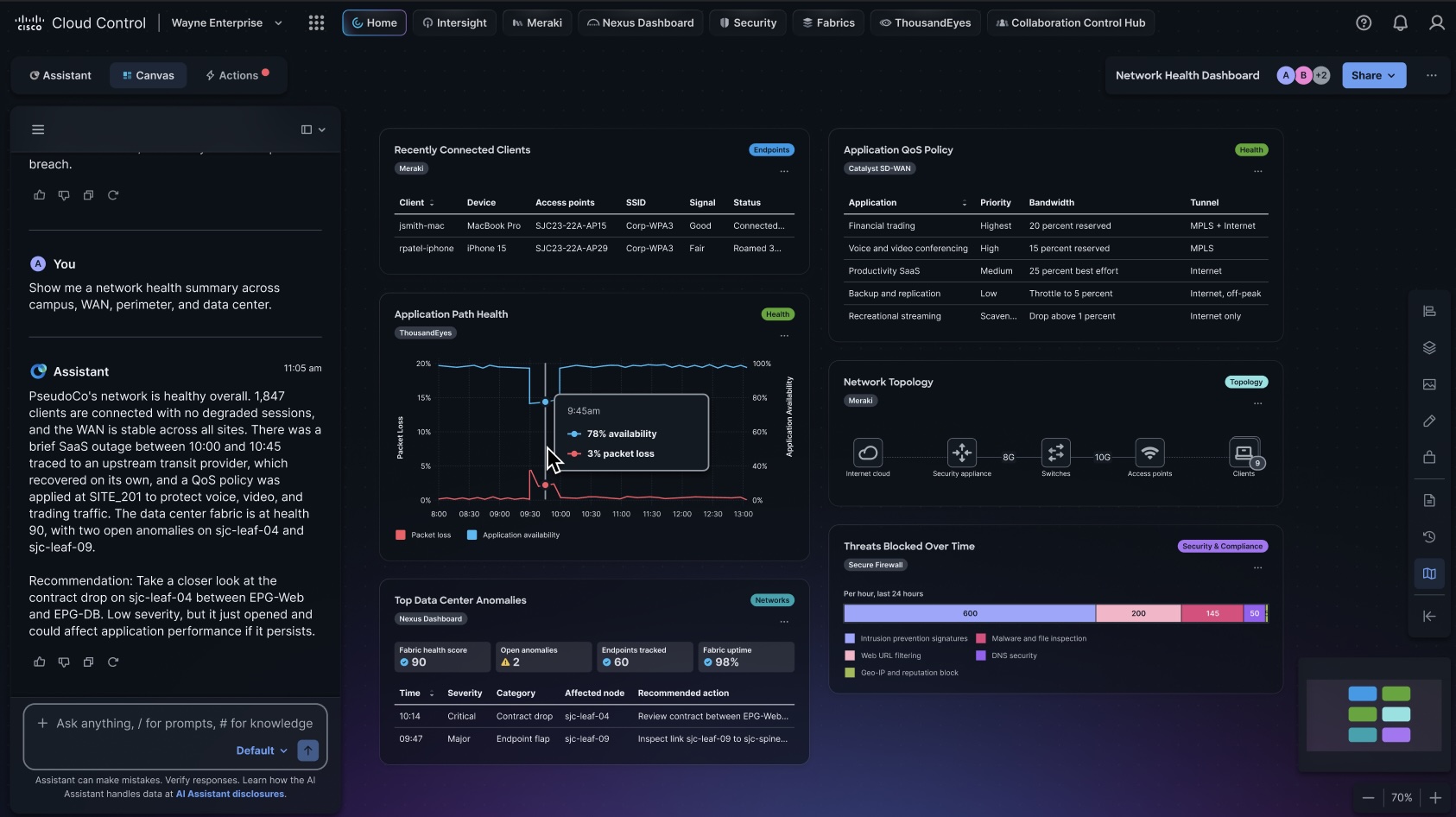

Inside an AI Canvas investigation
 

AI Canvas changes the operating model from manual investigation to agent-led investigation, with the operator in control.    

Operators ask questions in natural language. From a single prompt, AI Canvas runs a structured multi-agent investigation. It reads the question, identifies the domains involved, builds a plan, and dispatches specialized agents to gather evidence in parallel. AI Canvas synthesizes the findings into one sourced answer, with the reasoning trail visible so operators can defend the conclusion or hand it off cleanly. 

Default Mode powers the day-to-day experience. When operators need to check the health of a site, look at recent activity, or pull a quick view of an asset, Default Mode returns answers quickly with the relevant context. Most operational questions live here. 

For more complex incidents, this Controlled Availability release brings something new. 

What is new in Controlled Availability

This release introduces capabilities that make AI Canvas more useful for daily operations and more trusted for complex investigations.

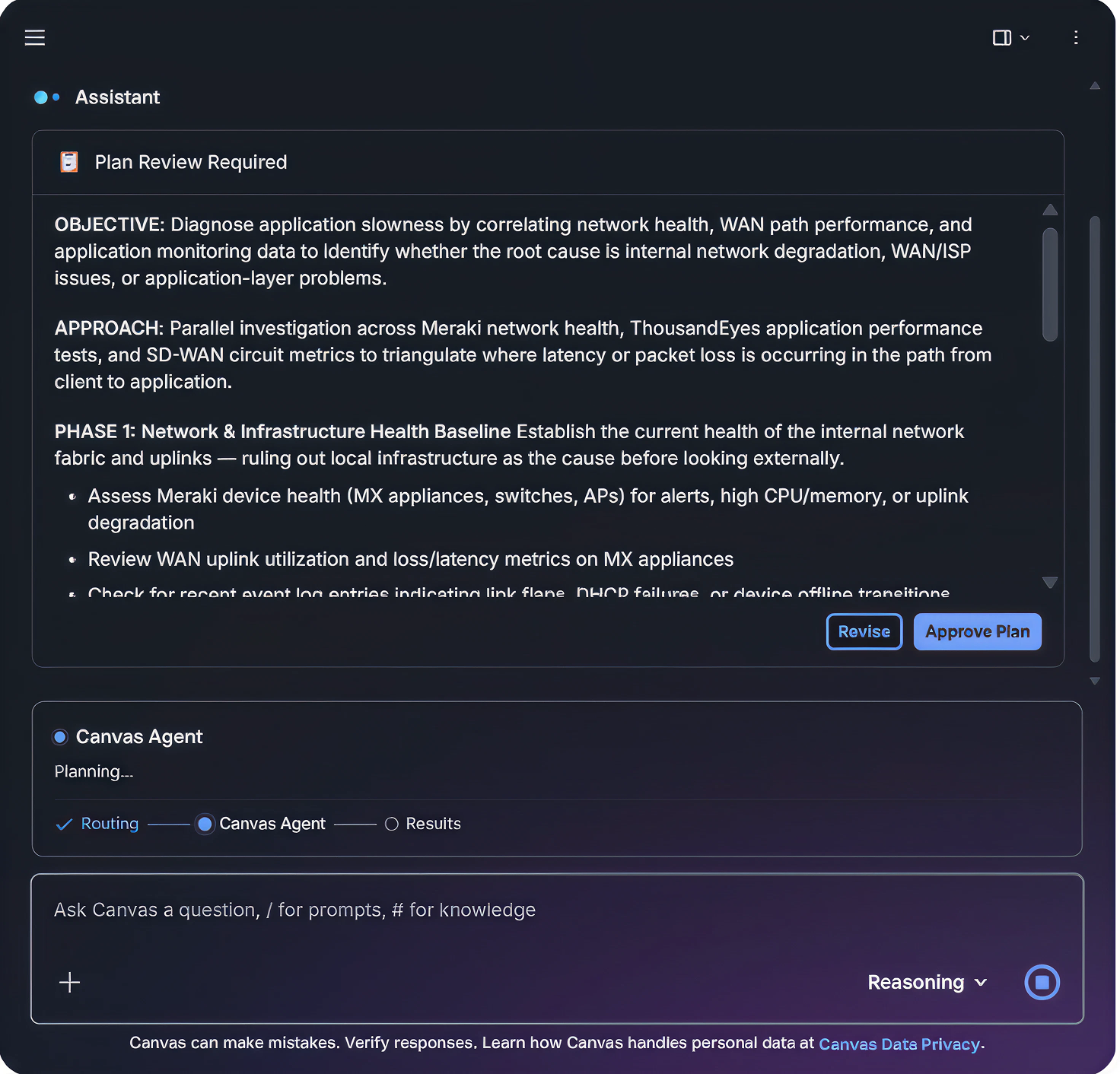
1. Deep Reasoning Mode is built for harder, multi-domain problems where teams need a clear, defensible answer. AI Canvas creates a full troubleshooting plan up front, grounded in best practice. The operator reviews, revises, or approves the plan before any agent runs. As the investigation proceeds, every step, finding, and conclusion is sourced and supported by evidence. Operators end up with an investigation that is easy to follow, easy to defend, and easy to hand off, especially when getting the answer right matters most.

Default Mode keeps everyday operations moving. Deep Reasoning Mode steps in when issues require deeper analysis.

2. Interactive generated widgets give operators the exact view they need for the question they asked, including topology maps, performance charts, summaries, and reports drawn from live data. Operators can click in, drill down, export, or push a widget into the next step of the investigation.

3. Multimodal context lets operators bring in the visual evidence they already rely on. Screenshots, dashboards, RF heatmaps, topology diagrams, and error images can become part of the investigation alongside live telemetry. The result is more complete investigations because AI Canvas reasons over the same evidence the operator is looking at.

4. Knowledge base built in lets teams bring runbooks, SOPs, and policies directly into AI Canvas. AI Canvas starts with Cisco best practice and becomes more specific to each customer’s environment as approved knowledge is added. The result is AI that follows the team’s standards, with investigations aligned to how the organization actually operates.

5. Board Library gives operators Cisco-curated starting boards for common scenarios, including security posture reviews, wireless troubleshooting, compliance checks, and application performance investigations. Each board is structured so teams can run a meaningful investigation immediately rather than start from a blank page.

Each of these capabilities exists because operators told us what an agentic workspace really needed.

Shaped by operators across industries

This release has been shaped by alpha and beta customers across industries – financial services, healthcare, retail, manufacturing, technology and more. Their teams ran AI Canvas against real environments, real incidents, and real operational patterns. They helped us refine what operators need from an agentic workspace: clear plans, sourced findings, useful visualizations, persistent context, faster investigation, and human control.

That feedback is visible throughout this release. We are grateful to every customer and operator who helped shape this milestone.

Designed for how teams work

AI Canvas is designed for how operators actually work. It is where humans and AI agents come together in one shared workspace, working from the same evidence, the same context, and the same proposed actions. Multiple teammates can join the same investigation in real time, while AI agents handle the heavy lifting of gathering context, correlating signals, and proposing next steps across domains.

Findings, decisions, uploaded files, and approved actions stay with the investigation across handoffs, shift changes, and escalations, so the next operator picks up where the last one left off rather than starting cold.

That continuity is what helps reduce MTTR. Instead of repeating work or rebuilding context, teams keep the work moving across people, shifts, and the AI agents working alongside them.

Customize & extend with Cloud Control Studio

Agent Builder in Cisco Cloud Control Studio was also announced at this year’s Cisco Live. It is a new part of Cisco Cloud Control, designed for customers and partners who want to extend the platform with their own tools, agents, and operational knowledge.

In Agent Builder, customers can do three things:

  • Connect third-party tools. Through native integrations or open Model Context Protocol connectivity, tools beyond Cisco can become part of how AI Canvas reasons across the environment.
  • Build custom agents. Customers can build agents tailored to their own operational needs, such as configuration drift monitoring, compliance checks, escalation workflows, or recurring incident investigations. Agents join investigations live inside AI Canvas.
  • Turn knowledge into reusable skills. Runbooks, SOPs, and procedures become reusable agent skills that any authorized agent can call during an investigation.

Teams can also discover, share, and adopt agents and integrations through the Cloud Control Marketplace, the third-party ecosystem inside Cloud Control. Marketplace gives teams a curated way to extend the platform with capabilities built by Cisco and partners.

Anything connected, built, or adopted through Cloud Control Studio and the Marketplace is usable in AI Canvas. The more tools, agents, and skills added, the more capable the workspace becomes for the customer’s specific environment.

Come see it at Cisco Live

Cisco AI Canvas, alongside Cisco Cloud Control, is entering Controlled Availability for United States commercial customers. If you are at Cisco Live, come see Cisco Cloud Control with AI Canvas at the booth for a live demo, or in sessions throughout the conference. Session catalog for AI Canvas here.

If you are not attending, visit the Cisco AI Canvas webpage to stay up to date on the latest product innovations.

Some products or features described may be in various stages of development and offered on a when-and-if available basis.