








Back when CIOs were first pushing for a center seat in the C-suite, the division of labor looked different. At that time, the responsibility of reshaping the organization's design wasn't part of the CIO mandate. Now it is. The shift came right after AI catapulted IT ahead -- and just before IT broke down.
"The reality is that IT no longer happens in the IT department," said Frederik Hagstroem, CTO at Emergn, a global technology consultancy. AI is not the reason, he added, "but it does accelerate the need for rethinking or rebooting the work operating system."
Beleaguered IT leaders are never looking for more things to do. However, one task can lead to another, even if that wasn't initially the plan. And when new technology shines a light on current issues, the to-do list lengthens.
"When you introduce AI agents that operate across procurement, finance and operations simultaneously, you expose that those boundaries were never designed; they were inherited," said Nik Kale, infrastructure engineer at a large networking company and member of the Coalition for Secure AI. "CIOs aren't redesigning org charts because AI is new; they're redesigning because AI made the old invisible structures suddenly visible -- and visibly inadequate."
Related:InformationWeek Podcast: Catching hidden errors in AI-powered code
While seeing is believing, actually solving the situation requires ongoing work. This is especially true when the IT environment is consistently undergoing change itself, as is happening right now.
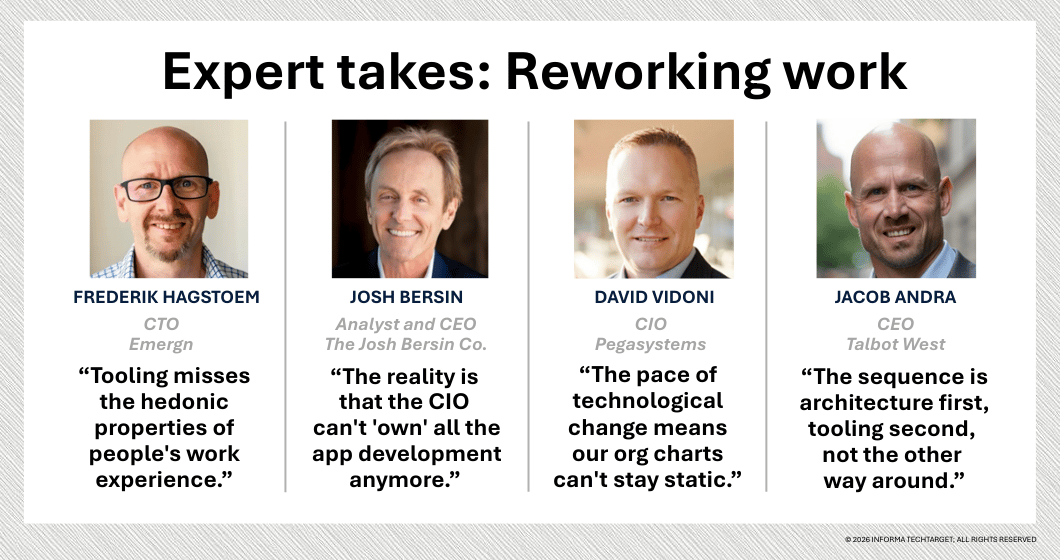
"AI is a major catalyst, but it's not the only driver," said David Vidoni, CIO at Pegasystems, a global software company. "The pace of technological change means our org charts can't stay static; they need to reflect new roles, cross-functional teams, and dynamic collaboration models that AI and automation make possible."
In the end, revamping the organization's design has simply become IT's best hope for managing and responding to rapid and ongoing change.
In the 1990s, business process reengineering (BPR) was heralded as the most logical path to modern optimization. And it was. But now that same path leads to a dead end, forcing CIOs to regroup and find a new way through.
"BPR assumed that processes were sequences of human decisions, with handoffs between them. You could map, optimize and re-sequence. Today's workflows aren't sequences; they're event-driven, adaptive and increasingly autonomous," Kale said.
In practice, BPR's linear assumptions no longer align with today's event-driven, multidirectional workflows. To make an informed decision on what comes after BPR, CIOs must first rethink what they need to focus on.
Related:Ask the Experts: The red flags that signal an AI project isn't worth pursuing
"The fundamental unit of work has shifted from the task to the decision, and most organizations haven't updated their operating models to govern decisions rather than tasks," Kale said.
That's not to say that BPR didn't offer benefits. Kale noted that it helped organizations accelerate handoffs between steps in a process. But faster handoffs are no longer the main challenge.
What organizations need now, he said, "is decision-rights architecture that defines where autonomy is permitted and where human judgment remains mandatory."
The short answer: process mining and task mining, observability and AI-assisted design tools, according to Jacob Andra, CEO at Talbot West, a digital transformation consulting firm.
"Process and task mining give you an empirical map of how work actually flows today; observability across apps and data shows where automations break and queues pile up; and AI-assisted design tools let you simulate and test new paths before you hardwire them into org charts and policies," Andra said.
There are numerous approaches and tools available to help redesign the work processes -- at least to a point. CIOs would be wise to explore where they might outsource some of this work, to both speed up implementation and divert energy toward more complex parts of the process.
Related:Shutterstock CTO's playbook for scaling AI without vendor sprawl
"For the pragmatic attributes such as efficiency, usability, speed and error rates, yes, tech tools can be very useful" Hagstroem said.
However, it's important to remember that while tools can help, they can't do it all. Some mining processing tools require deep knowledge and domain expertise before they can be effectively deployed. And all of them are unable to speak to the human perspective.
"Tooling misses the hedonic properties of people's work experience. For any reorganization, the human factors of trust, sense of control, identity and status require far more observation than any observability tool can provide," Hagstroem said.
Deciding which approach or tool mix is best for any given organization depends on its goals, current tech stack and staff preferences.
For example, there are several job design tools, said Josh Bersin, global industry analyst and CEO of the research and advisory firm The Josh Bersin Co. He cited OrgVue and other org networking tools as examples, but "many of them rely on surveys to understand what people are doing." AI-powered digital twins may be of more use in revealing what is actually happening.
Other tools observe digital work activity in the enterprise and model real-world workflows, which can be used as part of an org redesign. Bersin added his company uses a process they call "dynamic work design" to host regular workshops, where they take a look at workflows across teams so that AI agents can continuously be updated to improve processes.
Where CIOs get into trouble is by treating any tool as an 'easy button' subscription, warns Andra. Sometimes a plug-and-play platform is exactly what you need, he said, but "more often the missing piece is the systemic work of scoping the use case, checking technological fit and mapping dependencies and precursors.
"Only then can you decide whether the answer is a single product, a custom build or a hybrid. The sequence is architecture first, tooling second, not the other way around," Andra said.
Widespread organizational change can create friction, which the C-suite is expected to smooth over. The first step in managing this friction is to understand the cause.
"It usually comes from ambiguity about accountability. When processes change, people lose clarity about what they own and what they're responsible for. The architectural response is to make decision rights explicit and auditable from day one," Kale said.
But friction also rises from human fears, such as fear of job loss or the reduction of workplace power. Even CIOs can feel unsettled about their newfound place in the organization.
"The reality is that the CIO can't "own" all the app development anymore. Instead, they need to provide the tools, standards and programs to teach and enable others to build apps and consciously redesign and optimize work," Bersin said.
But in a time when massive layoffs and constant work changes are the norm, it may be hard for even CIOs to loosen their grip on the controls. Hagstroem acknowledged that IT today looks almost entirely different to how it did 10 years ago, with cloud being notably different from just five years ago. "AI looks different next month," he said.
Even so, Hagstroem said he believes it is highly unusual for a CIO not to adapt to risks and regulations, and to respond to new opportunities. It's far more common for CIOs to forge ahead, as is their duty, only to encounter resistance at many turns. One path through this resistance is to invest in a more collaborative process.
IBM has chosen to intentionally form "AI fusion teams" between the CIO and business functions, said Matt Lyteson, the company's CIO. IBM's AI fusion teams define the outcomes to be achieved through AI, run experiments to gauge the impact on workflows and engage employees to see exactly how their work changes.
"This collaborative approach has been a game-changer in helping us move quickly and effectively while implementing organizational and process change," Lyteson said.
此内容由惯性聚合(RSS阅读器)自动聚合整理,仅供阅读参考。 原文来自 — 版权归原作者所有。