
惯性聚合 高效追踪和阅读你感兴趣的博客、新闻、科技资讯
阅读原文 在惯性聚合中打开

推荐订阅源

Vercel News
Vercel News
Recorded Future
Recorded Future
CTFtime.org: upcoming CTF events
The GitHub Blog
The GitHub Blog
Application and Cybersecurity Blog
Google DeepMind News
cs.AI updates on arXiv.org
Microsoft Azure Blog
K
KPMG report finds enterprise disconnect between AI and its ROI | CIO
M
MIT News - Artificial intelligence
云风的 BLOG
云风的 BLOG
Y
Y Combinator Blog
N
News | PayPal Newsroom
freeCodeCamp Programming Tutorials: Python, JavaScript, Git & More
Help Net Security
Help Net Security
博客园 - Franky
SecWiki News
SecWiki News
Recent Announcements
T
Troy Hunt's Blog
The Register - Security
The Last Watchdog
The Last Watchdog
Webroot Blog
Webroot Blog
S
Security Affairs
博客园 - 司徒正美
S
Schneier on Security
I
InfoQ
博客园_首页
www.infosecurity-magazine.com
T
Threat Research - Cisco Blogs
Forbes - Security
Forbes - Security
腾讯CDC
N
Netflix TechBlog - Medium
N
News and Events Feed by Topic
Cloudbric
Cloudbric
T
The Exploit Database - CXSecurity.com
P
Proofpoint News Feed
A
About on SuperTechFans
Engineering at Meta
Engineering at Meta
Recent Commits to openclaw:main
B
Blog
V
Vulnerabilities – Threatpost
C
Check Point Blog
Google DeepMind News
Google Online Security Blog
C
Cyber Attacks, Cyber Crime and Cyber Security
Hacker News - Newest:
Hacker News - Newest: "LLM"
C
Cisco Blogs
Schneier on Security
O
OpenAI News
K
Kaspersky official blog

informationweek

2026 tech company layoffs How Sedgwick scaled AI in legacy claims workflows InformationWeek Podcast: CTOs on using AI in regulated spaces How top CIOs are measuring the real ROI of IT automation What AI must learn from Roosevelt, conservation and 1929 Experian's chief innovation officer gleans AI gains with startup collab ETS CIO on competing with AI startups 'running with scissors' Before the next VMware: How CIOs prepare for vendor shocks The strategic alignment powering cyber-resilient organizations The AI infrastructure bottleneck is becoming a CIO problem InformationWeek Podcast: CTOs on reining in rogue AI agents Workplace equity in the age of AI Why and how to implement an AI asset rationalization strategy Why companies are shifting toward private AI models AI agents in automation: When to build, when to buy Navan CTO AI on trial: The Workday case that CIOs can The AI infrastructure boom is coming for enterprise budgets How CIOs can manage LLM costs: A practical guide What CIOs miss when buying vertical SaaS software InformationWeek Podcast: How CTOs balance AI and their teams Whirlpool, Duke Energy, Cleveland Clinic CIOs on scaling AI Where CIOs get stuck rebuilding the enterprise: What 'Rewired' reveals As AI makes projects harder to track, will CIOs need new controls? Why disaster recovery plans fail in geopolitical crises A silent erosion of enterprise AI by data poisoning Priceline CTO prioritizes engineers able to 'hold a room and a roadmap' InformationWeek Podcast: When CTOs need to restart IT projects Wayfair CTO maps agentic path across digital and brick-and-mortar commerce The AI contract gaps the Google-Pentagon deal just made visible Non-human identity sprawl is agentic AI's real risk Outsourcing contracts weren't built for AI. CIOs are renegotiating now The AI spend hangover companies didn't plan for The power of CIO networking in the competitive AI world Why CIOs see AI projects stall: Speed without structure kills scale IT leaders should never let a good crisis go to waste SFO's digital twin maps airport operations from the curb to takeoff CIOs caught in the middle as AI startups disrupt vertical Saas Submit an IT Leadership column to InformationWeek Podcast: Rightsizing AI frameworks to avoid failure modes The invisible labor crisis inside IT: AI work the org chart can't see Why AI teams treat training data like capital Ask the Experts: How CIOs can identify and overcome cultural barriers to innovation Nobody told legal about your RAG pipeline -- why that's a problem Meta's new 'AI Zuckerberg' is a mirror for every C-suite Will the music stop for AI's funding dance? Rethink tech talent: Local is the smartest play for IT InformationWeek Podcast: Catching errors in AI-powered code CIOs can combat talent scarcity with AI-augmented leadership -- Gartner How Bellevue, Wash., is applying AI to streamline a broken permitting process Ignore the hype: Smarter tech bets at speed of change Who controls the fix? Colorado's repair fight tests CIO power Ask the Experts: The red flags that signal an AI project isn't worth pursuing The hidden high cost of training AI on AI Red Hat's Marco Bill: Resource control is key for AI sovereignty InformationWeek Podcast: New IT architecture, cloud, edge and AI Enterprises need Tier 1 provider relationships to deliver on AI How CIOs run and rebuild the business at the same time in the AI era It's not your tech stack, it's your structure -- fix it Confidential computing resurfaces as security priority for CIOs FinOps: Helpful tool, or a cloud control placebo for CIOs? Cleveland's open data overhaul: From sticky notes to public dashboards As Microsoft expands Copilot, CIOs face a new AI security gap Why build vs. buy doesn't fit modern IT systems InformationWeek Podcast: Is quantum computing slumbering? Your AI vendor is now a single point of failure Vibe coding: Speed without security is a liability A practical guide to controlling AI agent costs before they spiral AI fuels a new wave of technical debt The sunsetting of Sora: A hard lesson in AI portfolio resilience HP pushes broad internal AI use after early productivity gains Why value-based pricing is inevitable InformationWeek Podcast: Safeguarding ecosystems from outsiders Why AI scaling is so hard -- and what CIOs say works Humans are the North Star for AI-native workplaces -- Gartner How IT leaders build a culture for what comes next Compliance costs risk widening the AI gap AI-driven layoffs add new demands on CIOs to prove value AI transformation: Early wins are not enough for CIOs Why CIOs can't let users wait on IT Memory shortage doesn't have to spell disaster for IT budgets Accelerate AI adoption: 3 reasons for adopting MCP How techno-nationalism is complicating IT resilience and supply chains for CIOs InformationWeek Podcast: Compliance crackdown on AI and BYOD Workday’s AI reset: Agents and the race to remake SaaS Why enterprise AI initiatives keep dying before production Metrics of meaning: What do we really measure in AI? Techno-nationalism is reshaping CIO infrastructure strategy Using AI to pick team leaders -- without crossing legal or ethical lines What Oracle's layoffs reveal about running IT with fewer people Chief AI Officer on course-correcting when AI moves too fast Large enterprises need high-performing networks to scale AI InformationWeek Podcast: When do smaller AI models make sense? The future belongs to AI-driven IT Ways AI supercharges risk awareness and data insights for CIOs How automation prepares you for agentic NetOps Should the CIO, CFO or CEO hold the kill switch on AI? The CIO's new mandate: Redesign work itself Ask the Experts: CIOs say they wouldn’t pull workloads back from the cloud How AI is Reshaping the Enterprise
Anthropic's Mythos forces a rethink of vulnerability management
Kelsey Ziser · 2026-04-30 · via informationweek

In the 1979 Sci-Fi classic "Alien," Ellen Ripley refuses to break protocol, recognizing that an unvetted threat allowed past the airlock could endanger the entire ship.

Had the crew members of the USCSS Nostromo followed her lead, most of them would likely have survived. Instead, they were up against a threat that evolved faster than they could respond in a coordinated way -- a cinematic nightmare made real in recent weeks as AI-imbued security systems like Anthropic's Mythos show how attacks can slip through controls and outrun traditional defenses at machine speed. 

For CIOs, the emergence of Mythos and its ilk is a call to rethink the step-by-step protocols of vulnerability management for a reality in which attacks are automated and executed at machine speed before most teams can respond. 

Mythos testing exposes both zero-day and longstanding vulnerabilities

Earlier this month, Anthropic launched Claude Mythos Preview, a general-purpose language model to be used within Project Glasswing, which includes a select group of about 50 open source, technology and cybersecurity companies -- including AWS, Apple, Palo Alto Networks and Nvidia -- tasked with testing the AI model. 

Related:Cisco's Jeetu Patel on overcoming the 'AI trust deficit'

Mythos is being used by Anthropic and Project Glasswing to identify and exploit zero-day vulnerabilities in open source codebases. Anthropic's own testing of Mythos uncovered that the AI is "capable of identifying and then exploiting zero-day vulnerabilities in every major operating system and every major web browser when directed by a user to do so." The Mythos tests even identified some vulnerabilities that are over 20 years old. In addition, less than 1% of potential vulnerabilities uncovered by Mythos have been fully patched by their maintainers, according to Gartner. Over 99% of vulnerabilities revealed by Mythos haven't been patched. 

For its part, Anthropic is optimistic that the cybersecurity industry can adapt to AI-based threats. By releasing Mythos to a select group first, the company has argued that it is giving cybersecurity defenders a head start on patching vulnerabilities before similar AI models are widely available. 

"Once the security landscape has reached a new equilibrium, we believe that powerful language models will benefit defenders more than attackers, increasing the overall security of the software ecosystem. The advantage will belong to the side that can get the most out of these tools," Anthropic said.  

AI collapses the window between vulnerability discovery and exportation  

While Mythos is currently not generally available, bad actors are increasingly using AI to "develop more sophisticated AI-malware and accelerated adaptive attack campaigns," according to a report by research firm Omdia. As a result, the increase in AI-based attacks shakes up the traditional approach to vulnerability management. 

Related:Confidential computing resurfaces as security priority for CIOs

As bad actors use AI to autonomously generate code to hack into organizations, there's far less time to address vulnerabilities. "For years in the space of vulnerability management and exposure management, security teams were reliant on there being a gap between when there was a vulnerability discovered and when an adversary would have a working exploit to take advantage of that vulnerability, and that gap has collapsed," Kara Sprague, CEO of cybersecurity operations technology company HackerOne, told InformationWeek. 

In addition, Mythos can autonomously generate exploits -- it can "chain together and create complex exploits, and build exploits off of what might otherwise be considered lower-severity findings,"  Sprague said. 

That capability to generate working exploit codes to breach enterprise systems is previously unheard of by frontier LLMs, said Dennis Xu, an analyst at Gartner.

The speed with which vulnerabilities can now be identified and exploited makes vulnerability management much more challenging. Patching vulnerabilities has historically already been a time-consuming effort because it's typically an operations function, Xu explained. Organizations must run tests to ensure the patch doesn't break any software systems or customer-facing platforms. Companies then must determine when to implement a patch to avoid disrupting business operations. 

Related:Deepfakes become an enterprise risk for CIOs and CISOs

"Because defenders generally need to retool their teams, their operations and their processes, in addition to just adopting technology, their adoption on at least the company side tends to be slower than attackers are moving," Sprague explained.
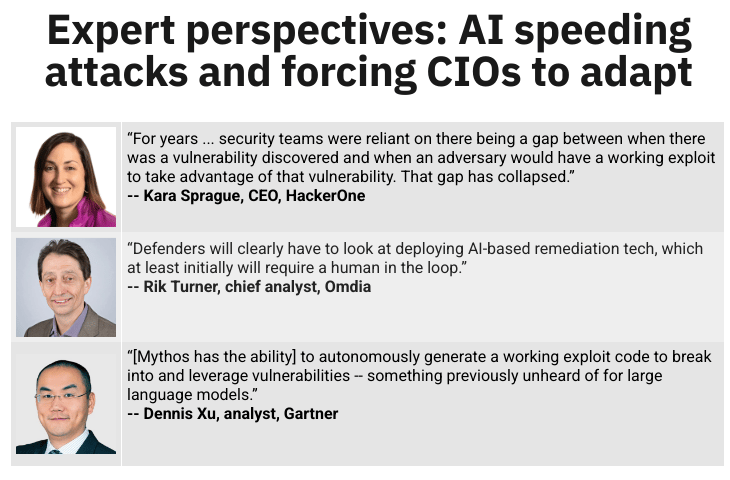
IT expert perspectives on Mythos

Solutions to AI-based threats

There's no time to waste in adapting cybersecurity strategies to account for AI-based threats. While Mythos is currently available to only a select group of companies that are part of Project Glasswing, other Frontier AI models will likely catch up to Mythos in the next three to six months, Xu said. And there's always the possibility that new AI models will be generally available. 

In the short term, CIOs and CISOs can keep a close eye on the cybersecurity companies participating in Project Glasswing -- such as Cisco, Palo Alto and Zscaler -- and when those companies release a patch, deploy it immediately within their own organization, he added.

In the long term, Xu said, vulnerability management providers can support enterprises by using AI models to identify software vulnerabilities more proactively. CIOs and CISOs can reexamine their vulnerability management cycle and should look for more ways to automate and speed up the remediation process. 

Omdia Chief Analyst Rik Turner echoed Xu's suggestion. "Defenders will clearly have to look at deploying AI-based remediation tech, which at least initially will require a human in the loop," he said.

Sprague also recommended using AI to thwart attacks from bad actors. She explained that organizations should consider utilizing cybersecurity platforms that can weed out false positives and validate if a vulnerability is exploitable.

About the Author

Kelsey Ziser

Senior Editor, InformationWeek

Kelsey Ziser is a senior editor at InformationWeek, where she covers C-suite dynamics, data strategies and the evolving cybersecurity threat landscape. 

Kelsey also oversees the publication's IT Leaders Fast-5 column, which brings peer insights to IT professionals, and the tech layoffs tracker. She has been with InformationWeek since September 2025. 

Before joining InformationWeek, she spent nine years at sister publication Light Reading, reporting on a broad range of topics including smartphones and devices, AI, satellite connectivity and enterprise networking. Kelsey has a Bronze Regional Azbee Award in the Technical Article category. Outside of work, she enjoys reading four (or 12) books at once, watching movies about space travel, crafting and tending to an ever-growing collection of houseplants. Kelsey has a bachelor's degree in journalism and mass communication from UNC-Chapel Hill and is based in Raleigh, N.C. She can be reached at [email protected] or on LinkedIn