

惯性聚合 高效追踪和阅读你感兴趣的博客、新闻、科技资讯
阅读原文 在惯性聚合中打开

推荐订阅源

钛媒体:引领未来商业与生活新知
钛媒体:引领未来商业与生活新知
T
Troy Hunt's Blog
P
Proofpoint News Feed
V
Vulnerabilities – Threatpost
C
Cybersecurity and Infrastructure Security Agency CISA
K
Kaspersky official blog
Cyberwarzone
Cyberwarzone
T
Tor Project blog
Cisco Talos Blog
Cisco Talos Blog
S
Securelist
L
Lohrmann on Cybersecurity
Security Latest
Security Latest
T
Threatpost
H
Heimdal Security Blog
W
WeLiveSecurity
A
Arctic Wolf
Cyber Security Advisories - MS-ISAC
奇客Solidot–传递最新科技情报
奇客Solidot–传递最新科技情报
G
GRAHAM CLULEY
IT之家
IT之家
freeCodeCamp Programming Tutorials: Python, JavaScript, Git & More
TaoSecurity Blog
TaoSecurity Blog
A
About on SuperTechFans
cs.CL updates on arXiv.org
N
News and Events Feed by Topic
Hacker News - Newest:
Hacker News - Newest: "LLM"
Last Week in AI
Last Week in AI
T
The Blog of Author Tim Ferriss
Threat Intelligence Blog | Flashpoint
Microsoft Azure Blog
Hugging Face - Blog
Hugging Face - Blog
Google DeepMind News
量子位
Stack Overflow Blog
Stack Overflow Blog
Know Your Adversary
Know Your Adversary
B
Blog RSS Feed
阮一峰的网络日志
阮一峰的网络日志
WordPress大学
WordPress大学
cs.CV updates on arXiv.org
AI
AI
OSCHINA 社区最新新闻
OSCHINA 社区最新新闻
博客园 - 司徒正美
Apple Machine Learning Research
GbyAI
GbyAI
Vercel News
Vercel News
C
Cyber Attacks, Cyber Crime and Cyber Security
Latest news
Latest news
D
Darknet – Hacking Tools, Hacker News & Cyber Security
大猫的无限游戏
大猫的无限游戏
Forbes - Security
Forbes - Security

BloombergNEF

Solar Set to Rule World’s Power Supply: Three Things to Know | BloombergNEF Energy Transition Impacts: Sector and Country Impacts from a Demand-Driven Model | BloombergNEF BloombergNEF Turkey Transition Factbook 2026: Clean Power Growth Positions Turkey for the Next Phase of Its Energy Transition | BloombergNEF Competitiveness, Cost and Climate: Five Themes From the BNEF Summit Amsterdam | BloombergNEF Electric Vehicle Outlook | BloombergNEF BloombergNEF’s Electric Vehicle Outlook 2026: Global EV Sales Set For Another Record-Breaking Year, But Growth in Some Major Markets Slows | BloombergNEF Mexico Transition Factbook 2026 Liebreich: The Great Clean Energy Acceleration 2.0 Global Clean-Energy Trade Rebounds to $479 Billion in 2025 Despite Tariffs and Geopolitical Turmoil: BloombergNEF New Energy Outlook 2026 New Energy Outlook 2026 BloombergNEF’s New Energy Outlook 2026: Transition to Newer Technologies, Expanded Electrification to Strengthen Nations’ Energy Security Energy Transition Bank Financing Struggles to Pull Ahead of Fossil Fuels in Asia Data Centers and the Future of Energy Storage Data Centers and the Future of Energy Storage Energy Storage Enters the 100-Gigawatt Era: Three Things to Know AI Data Centers, Energy and Finance: Dispatch from the BNEF Summit New York 2026 Nuclear Fusion Powers Up for Commercial Breakthrough BNEF Talk: Copper’s World of Wires, Wheels and Worries EU Carbon Border Tariff Is Reshaping Industrial Trade Flows BloombergNEF Announces 12 Climate Innovators as Winners of its 2026 Pioneers Award NEO 2025 New Energy Outlook 1 NEO Clean Power Is Up and Will Get a War Boost: Three Things to Know No, Iran War Won’t Boost Clean Hydrogen – Except in China The Petrochemicals Shock That Is Already Rippling Through Plastics AI Data Center Build Advances at Full Speed: Five Things to Know Iran Rattles Saudi’s Red Sea Oil Reset. Here’s What’s at Stake Bloomberg Appoints Albert Cheung CEO of BloombergNEF Oil Math of Releasing 400 Million Barrels: Three Things to Know Chinese Turbine Suppliers Seize the Spotlight as Global Wind Power Installations Hit All-Time High, BloombergNEF Report Shows New Data Center Hotspots Are Emerging: Four Things to Know Oil Products Arbs and Flows: All Eyes On Strait of Hormuz
Have Oil Prices Already Peaked? Three Things to Know
iterhorst · 2026-06-10 · via BloombergNEF
Oil Field Valve

June 10, 2026

By Victoria Xu, Oil Markets Analyst, BloombergNEF

An oil price rally has been evasive even though the Strait of Hormuz is largely closed and inventories are falling sharply. The oil market is dealing with a temporary supply disruption on top of a structurally bearish backdrop.

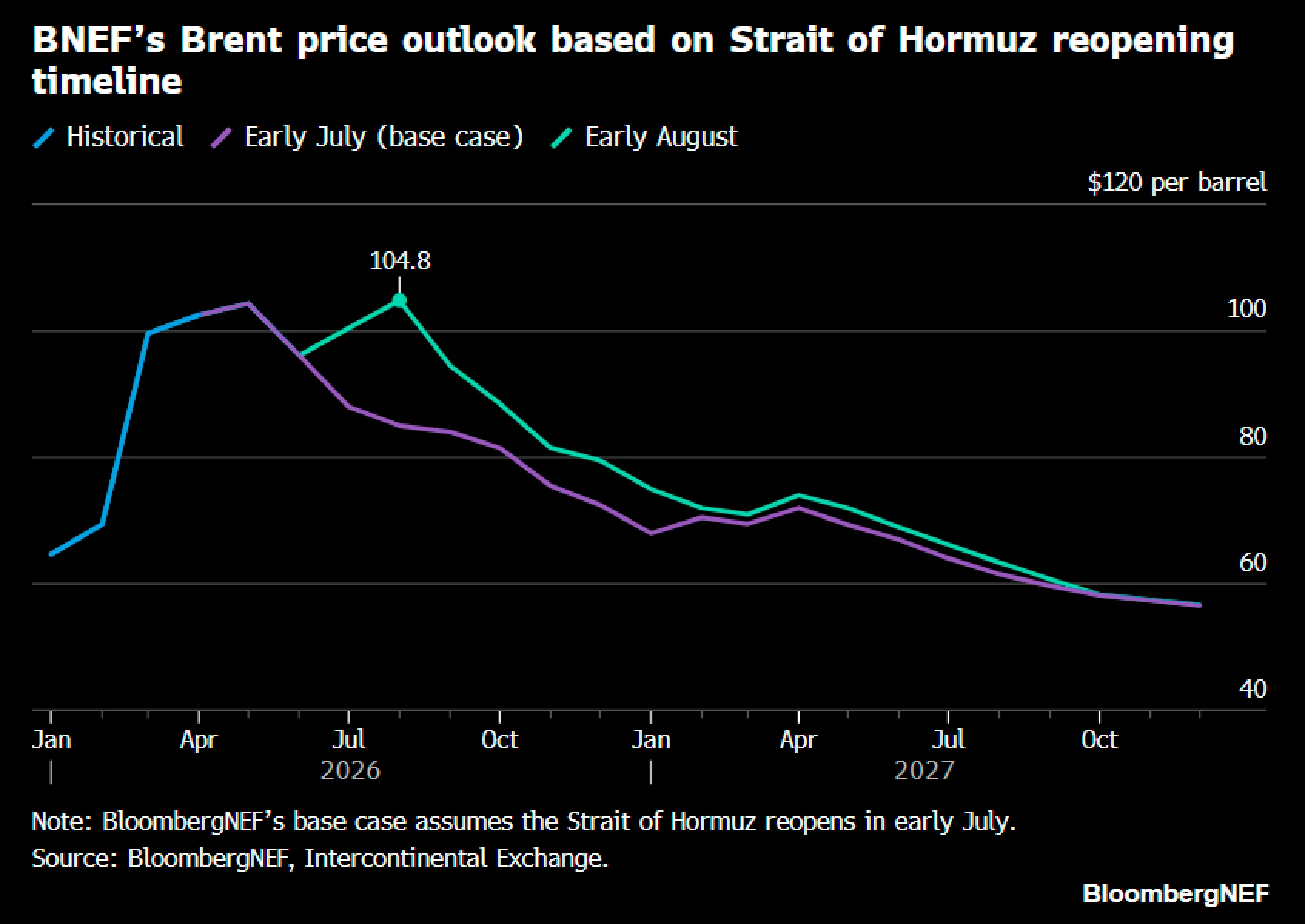
BloombergNEF’s oil price modeling reflects the possibility that Brent futures have already peaked just above $104 per barrel, or are close to peaking, when measured on a monthly average basis. Once the shock effect starts to fade, attention is likely to shift back to slowing demand growth and rising supply.
Three factors support the bearish view.

1. Oil demand growth is fading, and it looks structural

Oil demand is increasingly fragile, and the slowdown appears more structural than cyclical. Efficiency gains continue to reduce fuel intensity. Jet fuel demand remains below 2019 levels despite rising air traffic. Electric vehicles are taking a bigger bite out of gasoline demand. Internal combustion engine car sales in China fell 21% year-on-year in April, and the country’s gasoline demand appears to have peaked in 2023.

The demand drop is more significant for petrochemical feedstocks and cooking fuels, roughly peaking at 2.5 million barrels per day. Additional downside from price-driven demand destruction in transportation fuels may balance the market faster or at least slow the pace of inventory drawdowns. The conflict could keep demand growth weaker for longer, though the scale of the impact remains uncertain.

2. China’s stockpiles are quietly capping the upside

China has sharply trimmed its crude imports, reflecting both softening domestic demand and opportunistic stockpiling over the past several years, when sentiment and prices were low. This buying helped put a floor in the oil market by soaking up excess barrels and preventing a further price slide last year.

Today, those stockpiles work in the other direction, limiting the scope of the price rally beyond $120 per barrel. China has far less need to chase cargoes when prices climb with its storage tanks well supplied. Chinese inventories have inadvertently became a significant price-stabilizing force, capping the market on the way up just as they cushion it on the way down.

3. Supply is growing fast outside the Middle East

While demand softens, supply keeps expanding. Supply growth outside OPEC+ remains robust, especially in the Americas. BloombergNEF estimates that the supply growth in the region has exceeded 1 million barrels a day in recent years and will remain a major source of incremental supply through 2027.

A large cushion of Middle East supply is also waiting to return. BloombergNEF estimates that 80% to 90% of the production lost to the conflict can come back by the end of the year if the Strait of Hormuz reopens by early August. The recovery will be uneven, and some volumes, particularly in Qatar, could take years. On top of that, the UAE can tap more than 1 million barrels a day of spare capacity, adding further pressure. Iranian oil could also return under a deal to reopen the Strait of Hormuz.

As Middle East barrels come back on top of rapidly growing supply elsewhere, the market could swing from a deficit this year into a sizable surplus next year.

Counter view

BloombergNEF expects oil prices to remain near current levels through August, assuming the truce holds and both parties keep working toward a deal to reopen the Strait of Hormuz. If the Strait stays closed well beyond the summer, or fresh strikes damage energy infrastructure, prices would be pushed sharply higher and governments could be forced into more measures to curb demand.

Related Content

The latest from BloombergNEF delivered to your inbox

Sign up for BNEF’s free newsletter.