
惯性聚合 高效追踪和阅读你感兴趣的博客、新闻、科技资讯
阅读原文 在惯性聚合中打开

推荐订阅源

Microsoft Azure Blog
V
V2EX
博客园 - 【当耐特】
WordPress大学
WordPress大学
爱范儿
爱范儿
美团技术团队
宝玉的分享
宝玉的分享
钛媒体:引领未来商业与生活新知
钛媒体:引领未来商业与生活新知
小众软件
小众软件
量子位
Hugging Face - Blog
Hugging Face - Blog
B
Blog RSS Feed
Recorded Future
Recorded Future
Engineering at Meta
Engineering at Meta
雷峰网
雷峰网
CTFtime.org: upcoming CTF events
M
MIT News - Artificial intelligence
freeCodeCamp Programming Tutorials: Python, JavaScript, Git & More
博客园 - 聂微东
H
Hackread – Cybersecurity News, Data Breaches, AI and More
腾讯CDC
大猫的无限游戏
大猫的无限游戏
Jina AI
Jina AI
博客园 - 叶小钗
GbyAI
GbyAI
Y
Y Combinator Blog
Cyber Security Advisories - MS-ISAC
F
Full Disclosure
G
Google Developers Blog
D
Docker
T
Tailwind CSS Blog
C
Check Point Blog
Last Week in AI
Last Week in AI
人人都是产品经理
人人都是产品经理
T
The Blog of Author Tim Ferriss
B
Blog
博客园 - 三生石上(FineUI控件)
博客园 - Franky
H
Help Net Security
MyScale Blog
MyScale Blog
U
Unit 42
D
DataBreaches.Net
奇客Solidot–传递最新科技情报
奇客Solidot–传递最新科技情报
I
InfoQ
阮一峰的网络日志
阮一峰的网络日志
The GitHub Blog
The GitHub Blog
L
LangChain Blog
有赞技术团队
有赞技术团队
Martin Fowler
Martin Fowler
Microsoft Security Blog

TechWire Asia

AI Appreciation Day 2026 puts trust and governance in focus NVIDIA pours its full stack into Japan. The flip side of its China lockout? Malaysia's digital regulations are becoming a real cost for its startups Malaysia's AI data center vision: How EdgeConneX is building for the future Southeast Asia tech funding doubled to $7.4 billion. One company took most of it SK Hynix's Nasdaq listing raises $26.5 billion to fund Korea's AI memory expansion OpenAI launches GPT-5.6 for coding, cyber and science Meta rolls out Muse Image AI model for Instagram, WhatsApp, and advertisers Malaysia businesses face AI and password cybersecurity risks How AI workloads will test APAC mobile networks Enterprise AI costs don't have to spiral, argues ManageEngine Microsoft launches $2.5B Frontier Company for enterprise AI FIFA World Cup: How To Win Fans in APAC With Technology Kanga enters a new phase of global growth and launches Kanga Global Vertiv ramps up manufacturing in Johor's tightening data centre market U Mobile completes migration to own ULTRA5G network after DNB exit Anthropic Claude models launch in Microsoft Foundry on Azure Asia built the AI infrastructure boom. The BIS just flagged who's exposed if it stalls. Why Apple is lobbying Washington to buy China’s memory chips Nvidia-backed Firmus plans 170,000-GPU Batam AI data centre Taiwan robot makers march into humanoid systems IBM claims world’s first sub-1 nm chip technology using nanostack design Can Alibaba bridge Malaysia’s SME talent gap via agentic AI for business? Huawei’s new tech explains why mobile AI network tech is no longer optional Apple-Intel chip deal faces years-long production timeline China beats US in TOP500 ranking with world’s fastest supercomputer The global memory squeeze hits the Mainland China PC market, leading to a decline IBM joins OpenAI cyber program for vulnerability detection Is the Shopee ChatGPT integration the blueprint for the future of Southeast Asian e-commerce? How the global AI boom dropped a record RM1.127 trillion trade windfall on Malaysia Philippines expands Google Cloud public sector AI partnership South Korea takes a positive spin on AI Apple's price hikes trace the memory chip shortage straight back to Asia Why enterprises need clearer accountability for AI agents Google sues Chinese network over AI text phishing scams AI Won't Fix Broken Personalisation: Braze Report Reveals How Media and Entertainment Can Drive Real Success Across APAC Anthropic builds out Claude as OpenAI and Google stay ahead How APAC firms are handling software supply chain security Meta Business Agent turns WhatsApp into a salesperson, and Southeast Asia will decide if it works CrowdStrike: Chinese hackers lead tech sector espionage threats NVIDIA deals in South Korea cover AI memory, cloud and robotics Alibaba Cloud's Johor region launch comes packaged with an agentic AI push in Malaysia Digital Realty Malaysia is open and already looking beyond Cyberjaya AI’s invisible metal: Why tin demand is surging, and supplies are running thin WeChat is opening up to AI agents, and Southeast Asia’s super apps should be nervous TNG eWallet is eyeing agentic payments and its CEO sees Malaysia’s regulatory climate as encouraging AI data centres could double power and water use by 2030 TNG eWallet is no longer just a payment app, and the numbers prove it Nvidia GTC Taipei recap: RTX Spark, Vera, data centres and more Alipay wants AI agents to handle your payments. But who’s really in control? Huawei’s Her’s Law eyes AI chips as China reduces Nvidia reliance Kong Konnect now available in Singapore AWS is quietly building one of Southeast Asia’s most ambitious green data centre footprints China launches offshore wind-powered underwater AI data centre Has Huawei just rewritten the rules of chip design? OpenAI Daybreak and the patching cycle AirTrunk to invest MYR12 billion in Johor data centres China orders Meta to unwind Manus AI acquisition Kong reveals ‘agent-to-agent communication’ critical for Asian enterprises Huawei picked Malaysia for its biggest AI move outside China. Anwar told you exactly why. DeepSeek launches V4 model adapted for Huawei AI chips MATCH Act passes first hurdle–targeting semiconductor tools, not just chips The real cost of AI in APAC isn’t the software licence–it’s the mess underneath Cisco shows Universal Quantum Switch prototype to connect quantum systems The global smartphone market just had its worst quarter in two years, and memory is to blame Google Cloud introduces AI agent platform and new TPU chips at Next 2026 Tesla plans to use Intel 14A chips for Terafab project Meta deploys tracking tool to train AI on employee workflows Tuned Global’s service manipulation detector for streaming clients and rights holders Malaysia is rushing into AI faster than anyone. Its governance gap is the price Apple’s CEO transition puts a hardware engineer in charge–at exactly the right moment Memory shortage to persist through 2027 as supply lags demand xAI provides GPU infrastructure to Cursor for AI model training Amazon Leo just gave Southeast Asia’s satellite internet market a second player Meta extends Broadcom deal to develop AI chips Can Malaysia Build a USD1 Trillion Economy on the Strength of Its Geography? How will MyDigital ID progress in Malaysia? A chatbot is not an AI strategy Japan is building physical AI it controls–and its biggest companies are all in India is leading Asia’s agentic AI adoption race. The rest of the region is still catching up. Ericsson frames 6G as an intelligent fabric Mandatory AI literacy: China joins the UAE and India. Where is Southeast Asia? AWS AI revenue hits US$15 billion. Andy Jassy says the hard part is keeping up with demand Minor Hotels builds data and AI platform with Google Cloud The MATCH Act would cut off China’s last chipmaking lifeline–Asia is already feeling it Amperity expands to Australian AWS Regions and invests in local talent Chinese memory giants are scaling fast, and the AI boom is giving them cover Intel joins Musk’s Terafab AI chip project with Tesla and SpaceX TikTok’s second data centre in Finland a European push Custom AI chips, 3.5 gigawatts, and a quiet SEC clause: the Broadcom deal explained Kong names Bruce Felt as chief financial officer DeepSeek V4 points to growing use of Huawei chips in AI models Microsoft to invest $10 billion in Japan for AI and cybersecurity Which CRMs offer the most powerful reporting tools?
Southeast Asia leads the world in AI optimism. Its governance frameworks are nowhere near ready.
2026-04-16 · via TechWire Asia
  • Southeast Asia leads the world in AI optimism, but governance frameworks haven’t caught up.
  • Malaysia posted the largest AI optimism increase, although responsible AI maturity hasn’t kept pace.

Southeast Asia trusts AI more than anywhere else in the world. Stanford University’s 2026 AI Index Report, published this week, documents exactly how the gap between that optimism and its governance infrastructure has become.

In Malaysia, Thailand, Indonesia, and Singapore, more than 80% of respondents say AI will profoundly change their lives in the next three to five years. Malaysia recorded the largest increase of any country surveyed from 2024 to 2025, up nine percentage points on that measure.

North American and European respondents sit at the opposite end – lower excitement, higher nervousness. The US ranks 24th in generative AI adoption at 28.3%, while Singapore is at 61% and the UAE is at 54%.
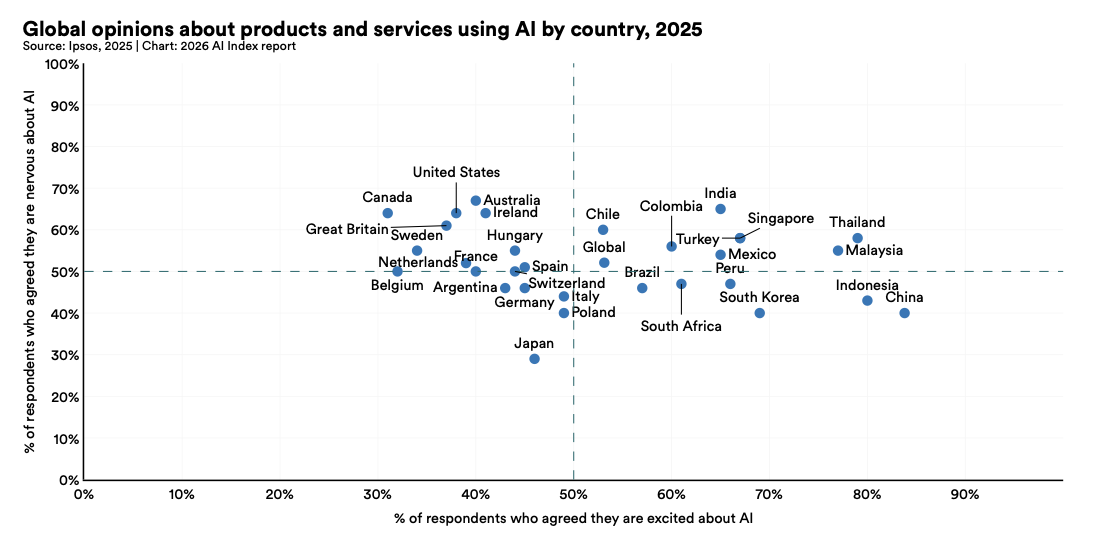
Thailand, Malaysia, Indonesia, and China cluster in the high-excitement, low-nervousness quadrant – visibly separated from North American and European markets. Source: Ipsos AI Monitor 2025, via Stanford HAI 2026 AI Index Report

The issue is what sits on the other side of that optimism.

High AI optimism, uneven governance

The Stanford report’s responsible AI chapter draws on a survey conducted jointly with McKinsey in multiple regions and industries. In 2025, the global average responsible AI maturity score was 2.3 on a four-point scale, meaning most organisations are still integrating responsible AI practices not having them fully operational.

Asia-Pacific registered 2.5, the highest regional score, but that still places the region firmly in the “integrating” band not anything approaching comprehensive operational control. The maturity scale captures whether organisations have responsible AI policies embedded into how decisions get made.

At 2.5, the region is ahead of North America at 2.2 and Latin America at 2.2 – but the gap between a score of 2.5 and the full operational standard of 4.0 is substantial. Knowledge and training gaps were the top obstacle to responsible AI implementation globally in 2025, cited by 59% of respondents – up from 51% in 2024. For a region where public AI enthusiasm is outpacing enterprise governance infrastructure, that skills gap is the most immediate vulnerability.
The trust picture and what it reveals

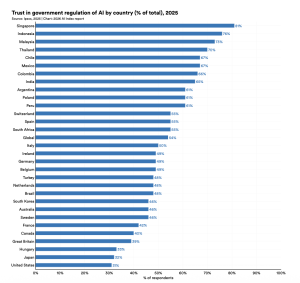
Southeast Asian countries rank among the world’s most trusting of their governments to regulate AI, with Singapore leading all 30 surveyed countries at 81%. The US sits last at 31%. Source: Ipsos AI Monitor 2025, via Stanford HAI 2026 AI Index Report

Southeast Asian countries report high trust in their governments to regulate AI. Singapore leads all 30 surveyed countries at 81%, followed by Indonesia at 76%, Malaysia at 73%, and Thailand at 70%. The global average is 54%. The US sits last at 31%.

That trust advantage is because government credibility creates the conditions for meaningful AI governance to be implemented and accepted. Countries where the public distrusts their government’s ability to regulate AI face a harder path to building the oversight infrastructure that responsible deployment requires.

But trust in government and the existence of adequate governance frameworks are not the same thing. The Stanford report notes that national AI strategies are expanding, particularly among developing economies, and that state-backed investments in AI supercomputing are rising. Yet model production remains concentrated in the US and China.

Southeast Asian countries are largely consumers and deployers of AI systems built elsewhere – which means the governance frameworks they develop need to account for dependency on foreign AI infrastructure, not domestic deployment.

Where the optimism-governance tension is sharpest

In India, China, Nigeria, the UAE, and Saudi Arabia, over 80% of employees reported using AI at work on a semi-regular or regular basis. For India specifically – which posted the sharpest rise in AI nervousness of any country surveyed, up 14 percentage points with a modest two-point increase in excitement – the picture is a region where use is accelerating faster than comfort.

Organisational support for responsible AI governance also shows a regional pattern worth noting. According to the University of Melbourne and KPMG global workplace survey cited in the report, India scored among the highest for organisational support of AI strategy and governance, with around 85 to 90% of respondents saying their organisation supports all three.

Countries at the other end of the scale – Japan and South Korea among them – reported the lowest levels of support for AI literacy and the least confidence in responsible AI governance. That split shows the highest workplace AI use and organisational commitment to governance is also the one experiencing the fastest-rising anxiety. High adoption and great concern are running simultaneously, which is precisely the condition that tends to produceregulatory action.

Malaysia’s position

Malaysia’s nine-point jump in AI optimism is the largest of any country in the Ipsos survey, and it arrives in a context the report doesn’t cover, but Tech Wire Asia readers will recognise. The country is the fastest-growing digital economy in Southeast Asia, holds around half of all planned regional data centre capacity, and has a prime minister who has committed RM2 billion to a sovereign AI cloud.

There is no national mandate for AI in school curricula – a gap covered separately in the Stanford report’s education chapter, which finds over 80% of Malaysian respondents expecting AI to profoundly change their lives, against a policy environment that has not formalised AI literacy at the school level.

Public enthusiasm outpacing policy infrastructure is not unusual in fast-moving markets. What makes Malaysia’s position distinctive is the scale of the infrastructure investment arriving with that enthusiasm. The governance question – who oversees AI systems operating on Malaysian data, in Malaysian data centres, under Malaysian regulatory frameworks that are still being shaped – will not wait for the enthusiasm to mature into policy.

What the numbers say

Stanford’s report documents where sentiment and governance infrastructure each stand and lets the gaps speak for themselves. What those gaps say is that a region with some of the world’s strongest AI confidence scores is building its governance capacity from a position of genuine institutional trust, which is an advantage, but on a compressed timeline, against systems and models it largely did not build, in a global regulatory environment where the EU is trusted more than any single national government to set the standards.

Want to experience the full spectrum of enterprise technology innovation? Join TechEx in Amsterdam, California, and London. Covering AI, Big Data, Cyber Security, IoT, Digital Transformation, Intelligent Automation, Edge Computing, and Data Centres, TechEx brings together global leaders to share real-world use cases and in-depth insights. Click here for more information.

Tech Wire Asia is powered by TechForge Media. Explore other upcoming enterprise technology events and webinars here.